
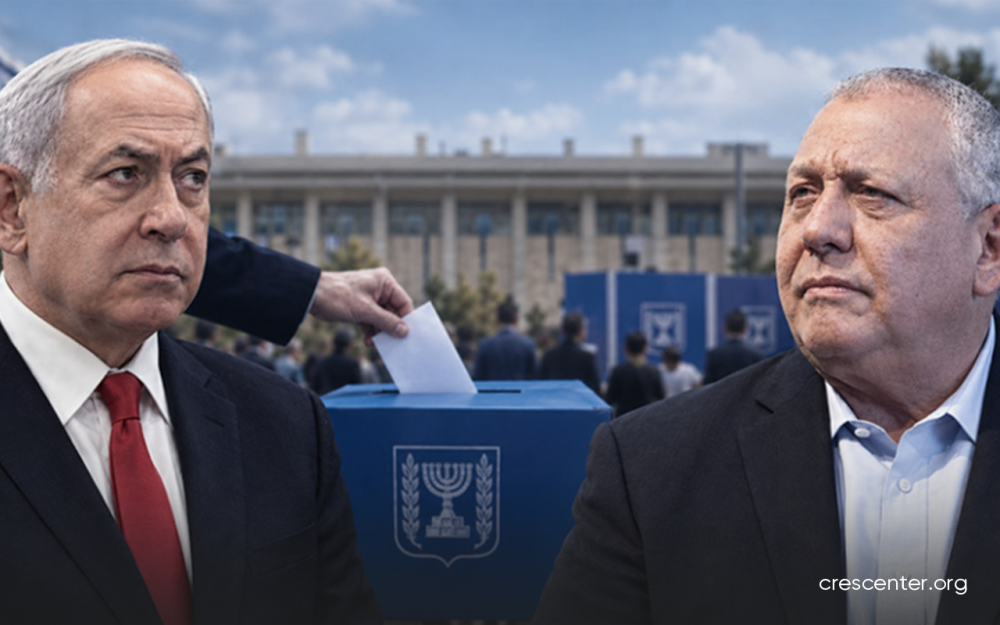
The Israeli elections held on 27 October 2026 represent more than a domestic contest for political power. They form part of a broader strategic debate over the future direction of the Middle East. According to the reported results, the bloc led by Benjamin Netanyahu secured 53 seats, the opposition led by Gadi Eisenkot won 48, and Arab parties collectively obtained 19 seats. Neither bloc reached the 61 seats required to form a government in the 120-member Knesset (Al Jazeera, 2026).
The results highlight the limits of Netanyahu’s political dominance while creating a potential opening for Eisenkot. Nevertheless, a change of leadership in Israel would not necessarily bring about a fundamental transformation of the country’s security doctrine or regional policies.
The central question is therefore whether a change in political leadership would alter the regional balance of power and the trajectory of ongoing conflicts, or whether established strategic priorities would largely continue under a different political approach.
Netanyahu and Eisenkot: Different Leaders, Similar Strategic Priorities?
Netanyahu’s political approach has placed military superiority and the Iranian threat at the center of Israel’s national security strategy. However, the failure to prevent the attacks of 7 October 2023, the prolonged nature of subsequent military campaigns and growing calls for political accountability have increasingly placed pressure on his leadership.
Former Israeli Chief of Staff Gadi Eisenkot presents an alternative based on his military experience and emphasis on institutional accountability and broader political consensus. Nevertheless, interpreting his political rise as evidence of a fundamental shift towards a more moderate Israeli security policy would be premature. Eisenkot has also supported efforts to limit Iran’s nuclear capabilities and weaken Hamas’s military capacity, while opposing the establishment of an independent Palestinian state (Reuters, 2026).
The principal distinction between the two leaders therefore appears to lie less in their overarching security priorities than in the political, diplomatic and military methods through which they seek to pursue them.
This distinction points to a broader feature of Israeli policymaking: national security decisions are shaped not only by the preferences of the prime minister but also by established institutions, political coalitions, military assessments and long-standing public debates. These factors can contribute to continuity in areas such as relations with neighboring states, deterrence policy and the management of the Palestinian question, even when political leadership changes.
For this reason, any assessment of a post-Netanyahu period should consider both the orientation of the incoming government and the institutional and strategic considerations that may constrain or guide its decisions. A change of government can create opportunities for policy adjustment, but it does not automatically produce a departure from existing priorities.
Iran: Can Military Superiority Deliver Lasting Security?
The US and Israeli strikes against Iran in 2026 have significantly affected the regional balance of power. Iran’s military capabilities and economic room for manoeuvre have come under considerable pressure, while maritime traffic through the Strait of Hormuz has also been disrupted.
A continued Netanyahu-led government could reinforce the prospect of sustained military pressure on Iran. Under Eisenkot, Israel might pursue similar security objectives through a more systematic approach and a different framework of coordination with Washington. The extent of any change would depend on the composition of the government, developments in Iran and the broader regional environment.
However, weakening Iran’s military capabilities would not necessarily secure its political capitulation. External pressure may encourage Tehran to negotiate, but it could also strengthen the influence of security institutions and reinforce a more assertive deterrence posture.
Israel’s military and technological capabilities remain significant, although sustaining prolonged, high-intensity operations can involve substantial operational, economic and diplomatic costs. Israel’s security partnership with the United States therefore remains an important factor in assessing its regional capabilities and the sustainability of its military posture.
This highlights both the limits of military power and the importance of Washington’s strategic calculations. Any renewed crisis in the Strait of Hormuz could also have serious consequences for energy markets, global trade and the European economy.
The central paradox is that reducing Iran’s military capacity may not resolve the underlying security challenges of the region. Without a complementary diplomatic framework, military pressure could create incentives for further confrontation rather than establish sustainable stability.
Palestine: Is a Change of Leadership Enough?
The most significant test of Israel’s elections will be their implications for the Palestinian question. Yet the rivalry between Netanyahu and Eisenkot does not indicate a clear policy shift towards accepting an independent Palestinian state. The future governance of Gaza, reconstruction, security arrangements and Palestinian political representation remain unresolved.
Meanwhile, continued settlement activity in the West Bank and restrictions affecting Palestinian territorial continuity remain important obstacles to the viability of a two-state solution. These developments have implications not only for the prospects of a negotiated settlement but also for regional diplomacy and the credibility of international efforts to support a political process.
Developments in the West Bank and Gaza should be assessed through their territorial, legal and demographic dimensions. Changes in property arrangements, administrative practices and patterns of movement can have lasting consequences for local communities and for the prospects of a negotiated political settlement.
Consequently, the formation of a government perceived as relatively more moderate would not, on its own, be sufficient to produce meaningful progress. Any substantive shift would need to be reflected in practical measures affecting Palestinian political rights, governance, freedom of movement and the conditions for a viable political future.
The international community also has an important role to play. Diplomatic engagement with Israel should be accompanied by consistent attention to the legal, political and humanitarian consequences of developments on the ground.
Regional Power Dynamics: Lebanon, Syria, Iraq and the Gulf
The rivalry between Iran and Israel, together with the broader regional policies of both countries, could generate additional security challenges for Lebanon, Syria and Iraq. The consequences will depend on how local political actors respond to changing power balances and on the extent to which external powers seek to influence developments.
In Lebanon, any reduction in Hezbollah’s military capabilities could create an opportunity to strengthen state institutions and national sovereignty. However, efforts to address the question of armed groups without a broader political understanding could generate further domestic tensions and instability.
In Syria, shifting power dynamics may create opportunities for reconstruction and institutional recovery. At the same time, external involvement, competing regional interests and unresolved domestic challenges continue to complicate the country’s stabilization process.
Iraq will need to maintain its relations with Iran while preventing its territory from becoming an arena for a wider regional confrontation. This will require careful balancing among domestic political forces, neighboring states and international partners.
For the Gulf states, the protection of energy infrastructure and the security of maritime trade routes remain essential priorities. Regional instability can affect investment, supply chains and the economic diversification strategies pursued by these countries.
Israel’s regional relationships and security activities also intersect with wider developments in the Eastern Mediterranean, the Red Sea and the Horn of Africa.
These areas have become increasingly relevant to discussions about maritime security, trade connectivity, energy routes and diplomatic influence.
Nevertheless, developments in these different regions should be examined in their specific contexts rather than treated as part of a single, uniform strategy. Security considerations, political influence and economic interests may carry different weight in each area, and the policies of regional actors are shaped by distinct local circumstances.
Three Possible Scenarios for the Coming Period
· Scenario One: Military Escalation.
Continued coalition deadlock in Israel, combined with renewed military pressure on Iran, could intensify regional retaliation and deepen existing energy-market concerns. In this scenario, the risk of miscalculation would remain high, particularly around strategically important maritime routes and energy infrastructure.
· Scenario Two: Limited Diplomatic Accommodation.
Pressure from the United States, together with the economic and security interests of regional states, could encourage efforts to contain tensions with Iran. Such an approach might reduce the immediate risk of escalation, although limited understandings would not necessarily amount to a lasting peace or resolve the underlying disputes.
· Scenario Three: Leadership Change, Strategic Continuity.
Whether under Eisenkot or a new Netanyahu-led coalition, Israel may experience a change in political leadership without fundamentally altering its principal security priorities. Policy approaches towards Iran, the Palestinian question and regional military deterrence could therefore retain significant elements of continuity, even if the methods and diplomatic emphasis change.
The third scenario is particularly significant because changes in political leadership do not necessarily lead to immediate changes in established security priorities or policy approaches. The balance between political renewal and institutional continuity will be an important factor in determining Israel’s regional posture.
Conclusion: The Pieces Are Shifting, but Can a New Regional Order Emerge?
Israel’s elections have exposed the limits of Netanyahu’s political dominance, while Eisenkot’s rise has introduced the possibility of a different political leadership. However, Israel’s regional policies cannot be understood solely through the personal preferences of its political leaders. They are also shaped by institutional structures, security assessments, coalition dynamics and the wider regional environment.
Political leadership may change, but policies shaped by state institutions, security priorities and long-standing political debates can retain considerable continuity. The defining factors in the coming period will therefore include the composition and orientation of Israel’s next government, whether the confrontation with Iran can be brought within a diplomatic framework, and whether a credible political roadmap for the Palestinians can emerge.
The greatest risk facing the Middle East is not simply the weakening of the existing regional order, but the failure to replace it with a more inclusive, stable and sustainable framework. Such a framework would require attention to the security concerns of regional states, respect for international law, viable political arrangements for the Palestinians and sustained diplomatic engagement.
The geopolitical pieces are shifting again. Yet genuine strategic change will not come from weakening adversaries militarily alone. It will depend on whether regional and international actors can address the political conditions that sustain recurring crises and create a credible basis for long-term stability.
Merve Alemdaroğlu - Political and policy analyst with an interdisciplinary background in international relations, security studies, and development cooperation. She holds a Master’s degree in Development and International Cooperation Science from Sapienza University of Rome.
The views expressed in the article are those solely of the author and do not reflect the policy or views of CRESCENT Research Center.