

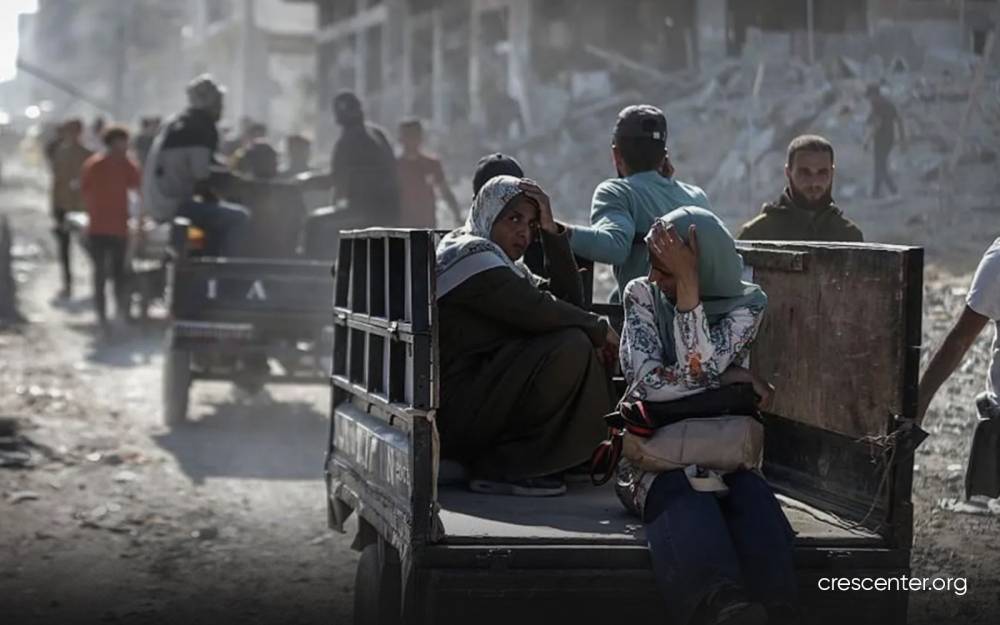
The ceasefire signed in Sharm el-Sheikh on 13 October 2025 marks a substantial pause in the Gaza conflict since large-scale operations began two years ago. The agreement, reached under Egyptian and Qatari mediation with active U.S. involvement, represents not so much a political breakthrough as a temporary convergence of interests among the main actors involved. After months of fighting, a humanitarian crisis of unprecedented scale, and growing diplomatic fatigue, both Israel and Hamas face an impasse in which continuing hostilities yield diminishing returns. The truce, therefore, functions as a mechanism to stabilize the situation on the ground and to create a framework for the negotiations that are expected to follow, even though none of the underlying political divisions have been resolved.
For Washington, the ceasefire is not an isolated achievement but a component of a broader regional approach. The Trump administration remains intent on bringing the war in Gaza to an end and securing the release of all hostages, but it views this process as part of a comprehensive strategy for reshaping the Middle East. That strategy revolves around Israel’s deeper integration into the regional system and the expansion of the Abraham Accords, which the administration envisions evolving into an overarching security and political framework that can be called as the “Abraham Order.” It aims to consolidate regional stability through the normalization of Israeli–Arab relations, the disarmament of groups such as Hamas and Hezbollah, and the containment of Iran through political and economic pressure. At the center of this policy lies the Gaza peace process, which seeks the eventual disarmament of Hamas and the transfer of civilian administration to the Palestinian Authority. Yet this is also where the greatest uncertainty resides. Israel’s response to the proposal remains ambivalent. Although Israeli officials do not reject the idea outright, skepticism runs deep regarding the Palestinian Authority’s capacity to govern Gaza or to prevent the reemergence of militant structures. For the moment, Israel appears content with the partial withdrawal of its forces beyond the yellow line, the phased release of hostages, and the maintenance of a limited calm while negotiations continue. The government’s position reflects a calculated balance and a desire to preserve operational freedom while avoiding a direct confrontation with the Trump administration, which prioritizes sustaining the ceasefire as a diplomatic success.
Hamas faces a different set of pressures. The movement has accepted the ceasefire under external coercion from Qatar, Egypt, and Turkey, whose mediation remains indispensable for any political arrangement. However, it refuses to accept the principle of complete disarmament, arguing that its weapons represent the only credible guarantee against renewed Israeli intervention and that demobilization must be linked to tangible progress toward Palestinian statehood. Hamas’s statements expressing readiness to cede administrative control to a Palestinian-led authority are therefore tactical, designed to signal flexibility without compromising its military core. This dual position of political accommodation without strategic concession defines the current equilibrium but also ensures that the conflict’s underlying dynamics remain unresolved. Israel, for its part, enters the ceasefire from a position of operational advantage but political constraint. After prolonged military operations and rising international criticism, the continuation of large-scale offensives had become increasingly difficult to justify, particularly in Western capitals. Most of the European measures taken against Israel were symbolic, yet they contributed to the perception that Israel’s international legitimacy was eroding. The September 9 Israeli strike in Doha, an attempt to assassinate Hamas officials that ended in failure and prompted a forced apology to Qatar, underscored the risks of overreach. The episode revealed both Israel’s willingness to act unilaterally when it perceives a threat to its security and its growing vulnerability to diplomatic repercussions. Despite these challenges, Israel remains confident in its capacity to shape its strategic environment and shows little inclination to alter its core security doctrine. The absence of a strong American reaction to the Doha incident further demonstrated the alignment of short-term priorities between Jerusalem and Washington. For Israel, the key is to maintain freedom of action while avoiding friction with its principal ally, while for the Trump administration, the priority is to preserve the ceasefire and to prevent the conflict from undermining its broader regional agenda. This implicit understanding provides the political foundation of the current arrangement, even as both sides pursue distinct long-term objectives.
The ceasefire also reaffirms Egypt’s central role as a regional mediator. Hosting the Sharm el-Sheikh summit allowed Cairo to reassert its indispensability in Palestinian affairs while keeping the conflict geographically contained. Egypt’s involvement is driven by pragmatic considerations, including stability along its border, the prevention of population displacement into Sinai, and the reinforcement of its diplomatic relevance. The proposed Egyptian-led stabilization mechanism for Gaza remains largely conceptual, but Cairo’s political capital depends on sustaining the truce and facilitating limited progress without assuming direct responsibility for governance.
As of now, the ceasefire continues to hold but remains vulnerable. Humanitarian assistance has expanded, hostages are being released in stages, and large-scale combat has ceased, yet none of the structural questions have been resolved. Hamas refuses to surrender its weapons, Israel resists any arrangement that diminishes its security control, and the mediators have yet to define the mechanism for Gaza’s political administration. The Sharm el-Sheikh agreement, therefore, remains formally in force but politically unsettled. Disagreements over Gaza’s future persist, and the obstacles to genuine stabilization are substantial. Hamas conditions its cooperation on political concessions it is unlikely to receive, Israel continues to seek guarantees that remain uncertain, and Washington’s regional partners are hesitant to assume the burden of enforcement. For the moment, the truce functions as an interim solution that postpones rather than resolves the central contradictions of the conflict. Its endurance will depend less on the written terms of the agreement than on the ability of mediators to maintain balance among actors whose objectives remain fundamentally divergent.