
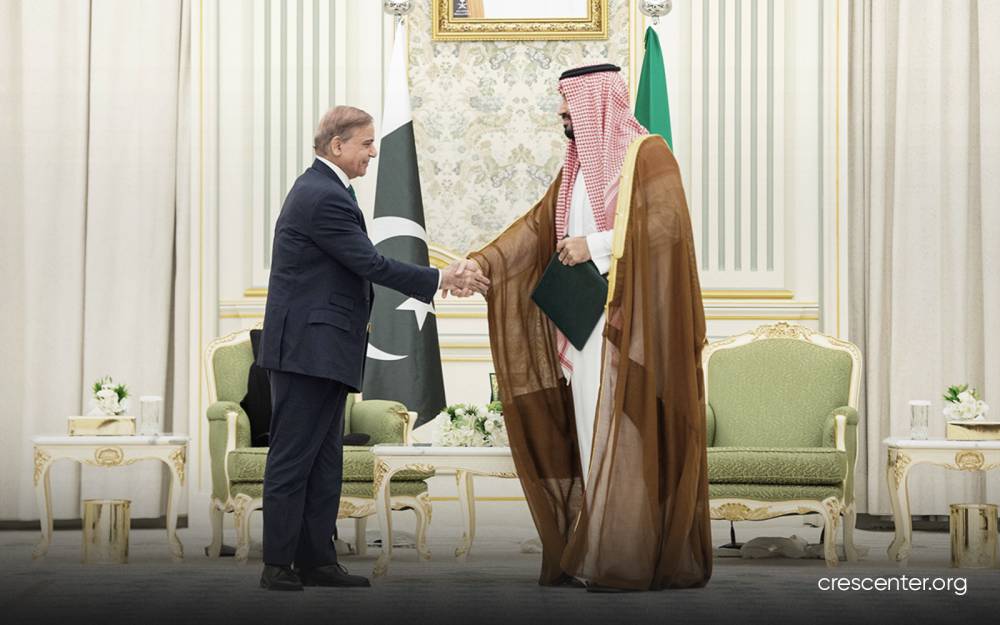
Saudi Arabia, as one of the most important political and economic powers in the region, with a military budget exceeding 70 billion dollars annually, has always been among the countries that spend a high percentage of their GDP on defense and military projects, and its military development policies have a history spanning more than a decade. Since Mohammed bin Salman came to power in 2015, economic and social development policies have been prioritized; thus, sustainable security has become one of the country's priorities. At first glance, the security agreement with Pakistan, under the conditions announced by political decision-makers, although stated to be for improving bilateral security itself, possesses challenging regional geopolitics.
Prefaces of the Saudi-Pakistani pact
With the growth of a development-oriented perspective in recent years, Saudi Arabia, with an approach to reducing tensions in the surrounding region, has tried to not only reduce hostility with its geopolitical rivals but also to diversify its cooperation and military alliances to moderate its reliance on extra-regional powers. For instance, regarding its de-escalatory efforts, one can refer to Saudi's endeavours to reduce the level of hostility in its relations with Iran, which, despite existing obstacles, completely balanced the threat of Iran and completely removed itself from the circle of escalating interactions between Iran and the United States. In terms of security diversification, regional military agreements with Persian Gulf countries to reinforce Peninsula Shield Forces and the purchase of military equipment from China are evidence of this.
The recent Israeli air strike attack against Qatar and the passive behaviour of US forces stationed at Al Udeid military base, both in terms of their lack of response and their failure to inform Qatari authorities, led to deep distrust against the credibility of the US security assurance in the region. As a result, the idea of diversifying strategic defense partners was strengthened. This issue, given Saudi Arabia's previous efforts, was considered a valuable opportunity to bolster its defensive partnership.
Regional impacts
The Abraham Accords, which were directly distorted by Israel itself through invading Qatar as a part of a strategic miscalculation, were a Schmittian model of regional security architecture based on the securitization of Iran. Although it claimed to maintain the security of Arab countries, by prioritizing Israel's offensive and military capabilities, it placed the Arab countries of the region in a subordinate position and as a second-tier priority. The initiative was considered to be more dependent on Tel Aviv's policies than anything else. Now, with Riyadh's initiative to diversify defense ties, this political and military pact is further weakened, and regional security-building alternatives are gaining momentum.
Given Saudi Arabia's history of conflicts with Houthi forces in Yemen, as well as conflicting interests with Iran regarding the "Axis of Resistance" and regional rivalries, military cooperation with Pakistan as a nuclear military power can be seen as an attempt to increase the cost of aggressive policies by other regional actors towards Saudi Arabia. For example, if the drone attack on Aramco in 2019 had no short-term consequences for the attackers, this issue would now be interpreted as much more complex. Accordingly, Israel has been particularly assumed to be the key factor for the creation of this pact since China’s mediation efforts among Iran and Saudi Arabia have already balanced both sides' positions.
With an active leadership role among the Persian Gulf countries, Saudi Arabia, has tried to empower the state's geopolitical agency rather than substate groups and for example, the idea of forming an Islamic or Arab NATO can be considered an outcome of this approach, and although it may not seem very practical in the short term, it has the potential to form cohesive regional power blocks.
Extra-regional outcomes
Traditionally, Iran played an important role in the geopolitical presence of China in the Middle East, and Riyadh's huge trade with China presented the geoeconomic impact of Beijing in the region. Now it is given that Pakistan's heavy and modern weaponry is highly dependent on Chinese technology, and its aerospace equipment, such as fighter jets, is directly purchased from China. Pakistan's defensive military cooperation in Saudi Arabia is interpreted as a form of indirect influence of the People's Republic of China on Saudi Arabia's defense policies. This issue of dynamic geopolitical change is particularly noteworthy due to Saudi Arabia's deep defense convergence with the United States of America.
China's behind-the-scenes presence in the Saudi-Pakistani defense agreement can be considered a form of Chinese geostrategic infiltration into the heart of the Middle Eastern energy market. The United States' efforts to reclaim the Bagram military base in Afghanistan, which was explicitly stated by the US President as a move to get closer to China's borders, can be interpreted as a response to this issue. It can be concluded that concerns about greater Chinese influence will further erode the United States' offshore balancing approach, forcing the United States to increase its military presence in the Middle East region.
The historical conflicts between India and Pakistan and the intense defense rivalry between these two nuclear-armed powers in recent years, and also the fear of the failure of the IMEC corridor, mean that India will also experience significant sensitivities regarding the military cooperation between Pakistan and Saudi Arabia. It is quite possible that to balance the current situation, India might seek closer ties with Saudi Arabia's regional rival, and perhaps the recent request by the Indian Prime Minister to the United States to allow entry into Iran's oil market after years of estrangement is related to this issue. Additionally, after the blockage of the Indian corridor through Iran under US sanctions, a new corridor of IMEC might lead India to boost its ties with Israel as a crucial part of the corridor.
The use of defense support from nuclear-armed countries has long been considered a solution to overcome security crises and territorial threats, and also to maintain the nuclear non-proliferation treaty. Currently, there are countries under such support, for example, Japan, South Korea, and Australia benefit from the nuclear umbrella provided by the United States, as do some of Moscow's allies like Belarus. However, in the current case, Saudi Arabia claims to be using the nuclear umbrella of a country that is not itself a member of the nuclear non-proliferation treaty. On a global scale, this issue can be considered a disruption to the non-proliferation regime, which could lead to reactions from international organizations.
Probable Scenarios
Saudi officials have occasionally alluded to Pakistan’s nuclear umbrella, but this is unlikely to become a serious pillar of Riyadh’s defense strategy. Pakistan’s political instability, uncertain foreign policy trajectory, and non-NPT status and internal limitations render such reliance both risky and politically costly, so nuclear ambiguity can be a better chance by regarding blurred remarks of both parties' officials in the media.
A more credible path lies in deepening defense ties with China. Indirect procurement of Chinese systems would strengthen Saudi bargaining power with Washington, enhance resilience against limited regional threats, and diversify military supply chains, reducing strategic dependence on the United States.
An obvious related scenario sees Persian Gulf states engaging Beijing as a form of strategic signaling—provoking the U.S. to maintain a robust regional presence and ensuring continued American defense guarantees. Here, China functions less as an alternative protector than as a lever to reinforce U.S. commitments.
A marginal scenario is that Saudi Arabia uses new defense agreements to resist U.S. pressure to normalize with Israel under the Abraham Accords without receiving a security guarantee from Washington. By exploiting Israel’s regional isolation and emphasizing interstate cooperation, Riyadh could weaken the substate model of security order and subtly expose divergences between Washington and Tel Aviv.
Finally, a less likely but destabilizing option would be renewed interest in Pakistan’s nuclear deterrent—this time directed less at Iran than at Israel or even the U.S. While improbable, such a move would introduce new uncertainty into Riyadh–Washington relations and regional deterrence dynamics.
Aliasghar Pirhadi
The statements in this review are the authors' own opinions and may not reflect the views of CRESCENT.