For almost a decade now, hyperinflation has become a norm for millions of Iranians. What were once considered alarm signals- soaring prices, economic instability, the threat of open conflict- have quietly normalised into the permanent conditions under which millions of Iranians now live. Long before the first Israeli missile struck Iranian soil in 2025, Iran’s economy was already on its knees. Decades of international sanctions, chronic mismanagement, and an over-reliance on oil revenues had hollowed out the purchasing power of ordinary Iranians and driven millions toward poverty. What the war did was accelerate a collapse that had been building for years.
The numbers tell a damning story. Iran’s annual inflation rate stood at 43.39% in 2021, barely shifted to 43.49% in 2022, and crept to 44.58% in 2023. These were not short-term spikes but a sustained, grinding erosion of living standards. The World Bank also noted that between 2011 and 2020 alone, the share of Iranians living below the international poverty line for upper-middle-income countries rose from 20% to 28.1%, with close to 10 million people falling into poverty over the decade, a period characterised by lack of economic growth and the compounding effects of sanctions. Sadly, food prices rose fastest and hardest, with the percentage of minimum wage required just to cover food expenses rising from 52% in 2020 to 65% by the end of 2024.
The roots of this crisis trace back to 2018, when the United States reimposed sweeping sanctions. Iran’s access to international banking was severed, its oil revenues cratered, and the Iranian Rial began a prolonged collapse, shedding more than 90% of its value against the dollar between 2018 and 2025. The government responded by borrowing heavily and printing money, both of which poured fuel onto an already raging fire. A MERIP analysis described the resulting economic order as one in which austerity became a governing tool, with scarcity generating profit for those with privileged access while the costs of every shock were pushed downward onto ordinary households. By 2023, official data showed 36% of Iranians living in absolute poverty, with analysts warning the figure had likely surpassed 40% by 2024 due to runaway inflation.
Then came the war. The direct military confrontation between Iran and Israel in June 2025 shattered what remained of economic stability. Iran entered the conflict already fragile, inflation was elevated above 50% and household purchasing power had been severely weakened. By late June 2025, the Rial was trading well above one million Rials to the US dollar in street markets. Israeli strikes targeted airports, oil facilities, power grids, and key industrial sectors, all crucial for Iran’s already fragile economy.
The economic shockwave continued long after the ceasefire. By December 2025, protests and strikes had erupted in downtown Tehran, with shopkeepers closing businesses in reaction to a free-falling currency that registered yet another all-time record low of over 1.42 million rials per US dollar. The unrest only deepened into the new year. What began as an economic protest quickly evolved into a nationwide political crisis, on 8 and 9 January 2026, authorities undertook a large-scale security response while implementing a near-total internet blackout. Human rights organizations reported significant casualties, with estimates of deaths ranging from 6,000 to more than 30,000. Amnesty International described the events as occurring on an unprecedented scale. The currency continued to depreciate rapidly into 2026, losing more than 20% in under 20 days by the end of 2025 alone, and annual inflation had exceeded 70% before a second wave of conflict began in February 2026, reaching its highest level since World War. The IMF estimated that Iran’s inflation would reach 68.9% in 2026, the highest figure since the 1979 Islamic Revolution, and projected GDP growth of just 0.3% for 2025.
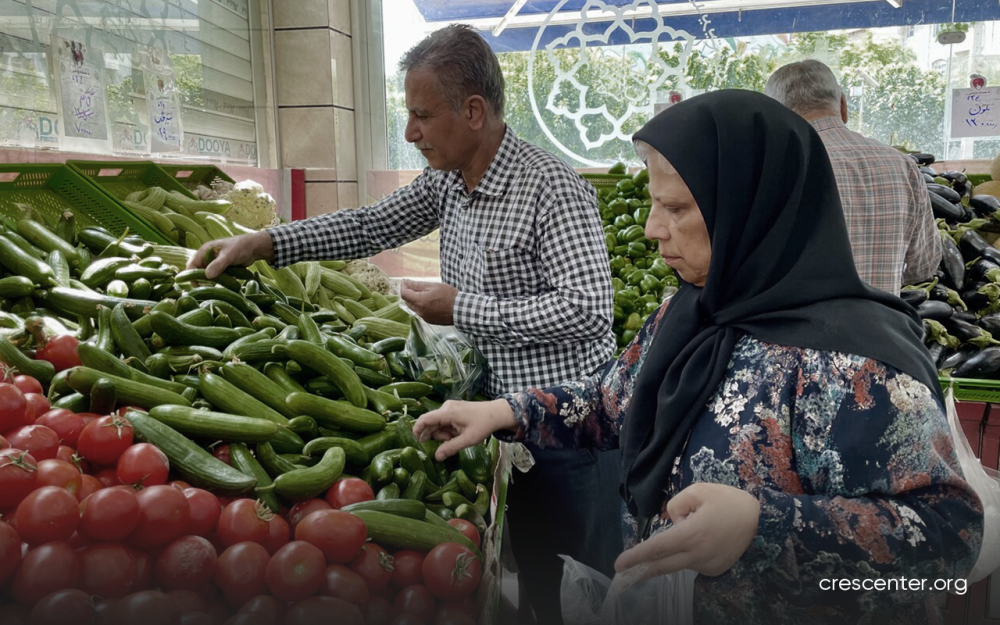
The human reality behind these figures is devastating. Food, the cornerstone of Iranian household culture, has become unaffordable for a growing share of the population. By January 2025, 25% of food items had already increased in price by more than 50% compared to the previous year, with potatoes recording a 103% increase and staples like rice, meat, dairy, and cooking oil all seeing dramatic surges. By May 2026, the World Food Programme reported that wheat flour prices had risen 124% compared to November 2025, before the rial’s most severe depreciation. Iranians began queuing in long lines for government-subsidised bread.
The gap between wages and survival costs has become unbridgeable for most working families. Based on an exchange rate of around 1,600,000 rials per dollar, the minimum monthly wage of 162,550,000 rials in early 2026 equated to roughly $104 — while average Iranian incomes had contracted to approximately $200 per month. Labour groups calculated that a family requires at least 50 million tomans per month simply to survive, more than double the official minimum wage. The government’s own food voucher programme — its primary safety net — was gutted in the 2025 budget, with allocations cut from 420 trillion rials to 150 trillion rials and the number of beneficiaries halved from 60 million to 30 million people. Food inflation reached 64% by late 2025 — far outpacing the official overall inflation figure of 48%.
Ordinary Iranians describe a life stripped back to the bare minimum. Citizens reported that even meals consisting only of bread and cheese required nearly an entire monthly minimum wage. In western Iran’s long-marginalised regions, demonstrators in towns like Abdanan stormed supermarkets and scattered rice across floors in what analysts described not as theft, but as reflecting broader economic grievances and public dissatisfaction with the rising cost of essential commodities.
What Iran is experiencing today is not simply the consequence of a war, nor simply the result of sanctions, it is the compounded result of all of these pressures colliding at once. The inflation crisis has not arrived from nowhere; it is the endpoint of a long trajectory of mismanagement, economic isolation, and prioritization of military expenditures over public services and welfare initiatives. With the IMF projecting no meaningful recovery in sight and inflation threatening to approach 70% by year’s end, the living crisis facing millions of Iranians shows no sign of decreasing. For a country once larger economically than the UAE, Turkey, and Saudi Arabia, all of which now boast economies more than three times Iran’s size, the distance between where Iran was and where it stands today is a measure not just of economic failure, but of an entire generation’s lost potential.
Parisa Azimi