
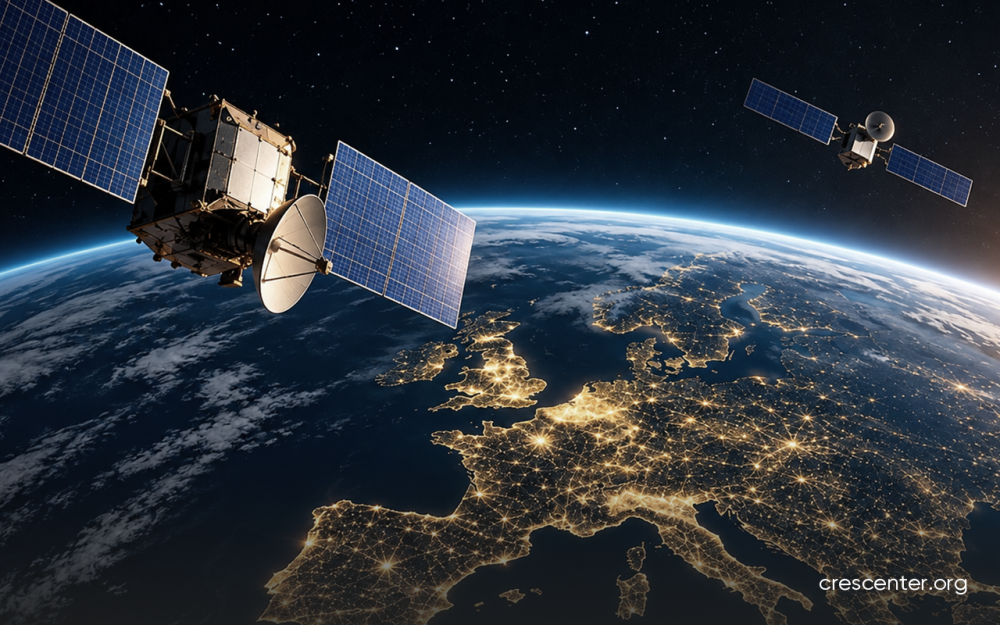
Turkish defense company ASELSAN, 74.20% of whose shares are owned by (Turkish Armed Force Foundation TAFF) announced Low Earth Orbit (LEO) Satellite Constellation Project named Astralink (GÖKBAĞI) and showcased its satellite prototype at the 77th International Astronautical Congress (IAC 2026) in Antalya. Prior to the announcement, a contract for the project was signed between ASELSAN and the Presidency of the Republic of Türkiye’s Secretariat of Defense Industries on May 6, 2026 during the International Defense and Aerospace Exhibition (SAHA 2026). The agreement was signed under the title “Low Earth Orbit Satellites and Military 5G/6G Communication System (GÖKBAĞI) Project.”
The Astralink project aims to reduce Türkiye’s dependence on space technologies by establishing a fully independent, uninterrupted and secure communications ecosystem, encompassing the entire process from microchip production to satellite constellation deployment. It will connect terrestrial networks with an integrated space-to-ground architecture.
The satellites planned for the project are expected to weigh less than 1,000 kilograms and have wingspans of approximately 9-9.1 meters. The system is designed to offer encrypted data transmission, enhanced anti-jam capabilities, on-board Active Electronically Scanned Array (AESA) technology, dual-use applications, high data capacity and low-latency communications.
ASELSAN has developed its own customized waveform. As Yusuf Bora Kartal, ASELSAN’s Executive Vice President for Communication and Information Technologies, explained, the system is built on a 5G foundation. He also noted that the company continues to develop technologies compatible with 6G standards, pursuing work beyond the scope of the 3rd Generation Partnership Project (3GPP) consortium.
Although the project is primarily intended for military applications, ASELSAN plans to expand its potential user base to include government agencies and public-service operators, such as first responders, firefighters, police forces, and healthcare providers. However, making Astralink's services commercially available to the wider public is not currently envisaged, primarily due to the cost per unit of data transmission. Kartal also highlighted the role of artificial intelligence (AI), describing it as both a customer and a tool. AI is expected to serve as a tool for managing satellite resources in orbit and optimizing resource allocation for terrestrially connected users.
Ahmet Akyol, General Manager of ASELSAN, stated that the project was launched at the end of 2025, with serial production scheduled to begin within the next two years and an initial constellation of 198 satellites planned. He added that ASELSAN currently has more than one million end-user terminals deployed in the field, which will be integrated into the Astralink project, enabling highly efficient and seamless communication solutions.
According to Akyol, the project is expected to increase Türkiye’s current communications capacity by up to 20 times. At IAC 2026, both Akyol and Kartal emphasized that Astralink will serve Türkiye’s military and government institutions, as well as its allies. Kartal also noted that, following the provision of services to military and government users, ASELSAN may consider extending the system’s services to the private sector, provided the necessary conditions and opportunities arise.
According to Kartal, a total of 198 satellites are planned for production. The first test satellite is scheduled for launch in 2028, while serial production is expected to begin in 2029. The entire constellation is projected to be completed by 2030. The contract value and overall project budget have not been publicly disclosed. Furthermore, despite the announcement of the estimated production and deployment timeline, several key details remain undisclosed, including the launch location, the launch service provider or platform, the launch schedule, the International Telecommunication Union (ITU) frequency registration, and the orbital parameters and designated orbital slots for the constellation.
ASELSAN has already launched its LUNA-2 satellite from California, USA, on March 30, 2026, using SpaceX launch services. Another Turkish defense company BAYKAR, together with its subsidiary Fergani Space Technologies, launched its sixth test satellite, FRG-100D4 from Florida, USA, on October 20, 2026, also using SpaceX services. Meanwhile, Türkiye is building a spaceport in Somalia as part of its efforts to reduce its dependence on foreign launch capabilities and develop greater autonomy in space technologies. Türkiye's geographical constraints, including the absence of an ocean-facing coastline suitable for certain launch trajectories and heavily used domestic airspace, are among the factors driving this initiative.
However, as Türkiye does not yet possess an independent operational capability to launch satellites into orbit, the launch arrangements for the Astralink constellation remain unclear. Therefore, it would be premature to assume that its satellites will necessarily be launched from the spaceport currently under development in Somalia.
To better understand the scale and potential capacity of the Astralink project, it can be compared with the EU’s Low Earth Orbit (LEO) satellite initiative, the Infrastructure for Resilience, Interconnectivity and Security by Satellite (IRIS²). The EU project, comprising 348 satellites, is expected to begin providing services in 2030. This constellation is significantly smaller than Elon Musk’s Starlink network, which comprises approximately 11,000 active satellites.
SpaceX’s Starlink is a commercial satellite internet service. However, SpaceX also operates Starshield, a satellite system developed for the Pentagon and intended for U.S. military applications, as Elon Musk has highlighted. The distinction between these two systems, particularly in terms of their technological capabilities and military applications, is becoming increasingly blurred.
Furthermore, SpaceX’s services have been used by Ukraine on the battlefield. However, President Volodymyr Zelenskyy has recently claimed that SpaceX restricted its services, disrupting Ukrainian drone operations and affecting the country's defense capabilities. This case illustrates the strategic importance of developing independent space technologies and secure satellite communication capabilities, particularly for countries seeking to safeguard their national security and maintain operational autonomy.
STEEL DOME AND NATO
Türkiye is developing Steel Dome, a national multilayered air and missile defense system, designed to counter a range of aerial threats. The project involves several Turkish defense companies, including ASELSAN, ROKETSAN, MKE, TÜBİTAK SAGE, and local subcontractors. ASELSAN’s Astralink is expected to play a central role in Türkiye’s Steel Dome architecture, providing seamless, cybersecure, and encrypted communications between the system’s various components and assets.
The recent Iran–Israel/U.S. conflict has highlighted the importance of aerospace defense technologies for Türkiye. In March 2026, four ballistic missiles were launched from Iran and entered Turkish airspace, where they were intercepted by NATO assets. This incident reinforced the importance of Türkiye’s NATO membership and highlighted the potential security implications of regional escalation for other NATO allies.
NATO has already been developing its policies on space and emerging technologies. On October 17, 2024, NATO launched the STARLIFT project to address potential challenges related to the use of and access to space. Currently, 15 countries, including Türkiye, participate in the initiative.
In addition to STARLIFT, NATO has introduced the Hybrid Alliance Layered Operations in Space (HALO) initiative, which aims to develop a networked mega-constellation integrating the military satellites of NATO allies while preserving their sovereign ownership and national control. The initiative was launched at the 2026 NATO Ankara Summit and currently involves eight allies, including Türkiye.
In this context, Astralink, which is expected to play a central role in Türkiye’s Steel Dome architecture, could potentially become relevant to NATO's broader space and defense capabilities. However, no official announcement has been made indicating any direct integration of Astralink into NATO's initiatives. Therefore, interoperability and selective contributions to shared capabilities appear more realistic prospects in the near term than formal integration into NATO's space architecture.
CONCLUSION
Astralink project reflects Türkiye’s ambitions to reduce dependency on foreign space technologies. Given the high costs associated with developing and maintaining these technologies, the need for exports and international cooperation is likely to emerge over time. This makes access to new markets increasingly important. This makes access to new markets increasingly important. As Türkiye’s defense industry continues to advance, the country has opportunities to establish partnerships and agreements that could facilitate access to regional MENA markets. Examples of emerging defense cooperation frameworks include the Mecca Defense Agreement involving Saudi Arabia, Pakistan, and Türkiye, and the Badr Agreement involving Qatar, Indonesia, Pakistan, and Türkiye. Astralink could potentially be positioned as a secure communications platform for these countries. However, this remains a prospective scenario rather than an established direction, pending the announcement of specific export or cooperation agreements.
The sooner Astralink demonstrates the feasibility of its launch strategy, spectrum allocation, and cost model, the stronger its position will be. If successfully implemented, it could become not only a strategic asset for Türkiye but also a viable option for its allied countries.
Şeyma Özdoğan - Master student of International Relations at Kadir Has University, where she also served as an assistant in the Department of International Relations.
She has completed internships at the Istanbul Peace Research Center (IPRC) and Global Academy; took a part as a project assistant on the “Turkey’s NATO Membership in 75 Questions on the 75th Anniversary of the Alliance” project. She has also volunteered with The German Marshall Fund of the United States, the Global Relations Forum and the Elele EU Project.