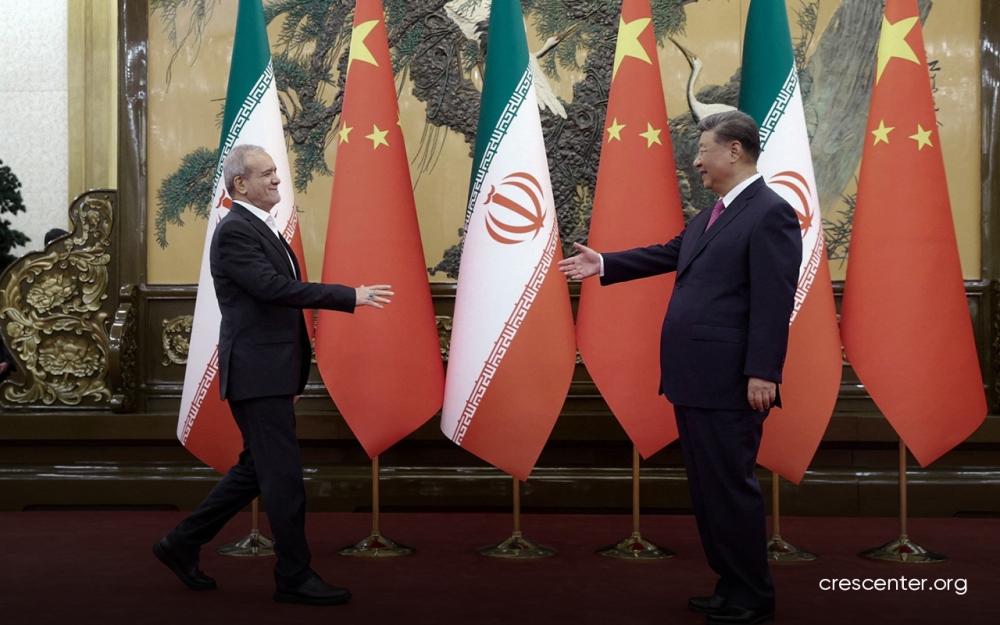
When examining Sino-Iranian relations, analysts and scholars have often characterized the relationship through terms such as “strategic partnership” or, in some cases, “strategic alliance.” Others have portrayed Iran as China’s “gas station,” emphasizing its role as a reliable supplier of energy. However, a closer examination of China’s conduct during the 2026 Iran War and Operation Wrath of Hamas suggests that Iran’s diplomatic establishment has long operated with a fundamentally flawed understanding of Beijing’s approach to coalition-building and foreign policy. Moreover, a considerable number of international scholars and analysts have interpreted this relationship through an analytically problematic lens. One of the principal weaknesses of Iran’s foreign policy apparatus and political elite lies in their limited understanding of Chinese strategic thinking and political philosophy. The foundational principles of most states’ foreign policies are deeply rooted in their respective political traditions and philosophical frameworks. Although Iran possesses a rich Islamic-Iranian political tradition, it has not developed a sufficiently robust scholarly and analytical understanding of the Chinese worldview. As a result, Tehran has repeatedly fallen into cognitive errors, strategic miscalculations, and interpretive distortions when assessing the nature, extent, and reliability of Chinese support.
The 2026 Iran War starkly exposed this problem. By closing the Strait of Hormuz, Iran demonstrated a willingness to place Chinese interests at risk alongside those of the United States and its allies. Although China offered Iran rhetorical and diplomatic support, it simultaneously insisted on the need to keep the strait open. In his conversation with the Saudi Crown Prince, President Xi Jinping explicitly emphasized the importance of maintaining normal passage through the Strait of Hormuz. This divergence between the rhetoric of “strategic partnership” and China’s practical pressure on Iran to protect its own interests is highly revealing. Iranian policymakers, having incorporated China into their strategic calculus as an ally, likely viewed Beijing’s conduct during the conflict with disappointment. Nevertheless, constrained by national imperatives and diplomatic limitations, they refrained from publicly criticizing China.
Beyond its economic power and influence over global markets, China is also shaped by a distinctive historical and civilizational identity that privileges mediation, equilibrium, and the pursuit of stability. Yet, as Chinese foreign policy has matured, mediation has increasingly evolved from a normative commitment to peacemaking into a form of interest-driven conflict management. Accordingly, China acted as a mediator not primarily on behalf of Iran, but in defense of the broader stability of the Persian Gulf order. In practice, Beijing engaged more extensively with Saudi Arabia, Pakistan, Qatar, Kuwait, Bahrain, the United Arab Emirates, and the United Kingdom than with Tehran alone. China’s Ministry of Foreign Affairs highlighted President Xi’s four-point proposal for peace in the Middle East and the restoration of normal shipping through the Strait of Hormuz, while also emphasizing Foreign Minister Wang Yi’s frequent contacts with officials from Qatar, Pakistan, Bahrain, Kuwait, Saudi Arabia, and the UAE. In this conflict, China demonstrated that although Iran is important, the stability of the Persian Gulf is more important.
China had previously accumulated substantial symbolic capital through its mediation between Iran and Saudi Arabia. However, the war revealed that diplomatic agreement-building and hard-security crisis management are fundamentally different domains. Official Chinese sources sought to project the image of a responsible major power, even as China’s network of regional partnerships came under strain. Beijing maintains close relations simultaneously with Iran, Saudi Arabia, the UAE, Israel, and Turkey; therefore, its regional policy is necessarily shaped by balancing, flexibility, and the avoidance of costly commitments.
Another dimension of Iran’s cognitive misperception concerns the assumption, prevalent within parts of its foreign policy establishment and political elite, that China’s ideological and geopolitical rivalry with the West naturally aligns Beijing with Tehran. This assumption has generated expectations of comprehensive and unconditional Chinese support. In reality, China conceptualizes its contradictions with the West in segmented and compartmentalized terms rather than as a total or absolute confrontation. Beijing consistently preserves room for maneuver, interest redefinition, and pragmatic relationship management. The nature of China’s competition with the West differs fundamentally from Iran’s confrontation with it. Although reports of Chinese arms transfers to Iran and the provision of satellite imagery circulated in security and international circles, Beijing avoided formal hard-security commitments during the war. Once again, China adopted a cautious and limited approach, reflecting both the transactional nature of its relationship with Tehran and the limits of its hard-power projection in the Middle East. This gap is analytically significant: the war demonstrated that Iran may be able to rely on China for oil purchases, diplomatic support, and perhaps certain forms of dual-use technology, but not for direct defense guarantees or security commitments.
Iran’s strategic interpretation of China during this conflict reveals that Tehran continues to understand Chinese political thinking in excessively ideological and anti-Western terms. Iran assumes that because China challenges the U.S.-led order, it will stand beside Tehran as a pillar of an anti-Western coalition during moments of crisis. Yet China’s strategic logic is shaped primarily by regime survival, domestic stability, economic growth, and the avoidance of uncontrollable costs. Beijing views Iran as a useful partner for diluting American pressure, securing discounted energy supplies, and expanding non-Western institutional frameworks such as BRICS and the Shanghai Cooperation Organization. This, however, does not amount to a security commitment or a destiny-shaping alliance. Even American analytical reports emphasize that, despite its expansion, the Sino-Iranian relationship remains asymmetrical: Iran is far more dependent on Chinese oil purchases and diplomatic backing than China is on Iran. Beijing, by contrast, carefully balances its relations with Saudi Arabia, the UAE, and other Gulf actors. Whereas Iran perceives its rivalry with the West as existential, identity-based, and confrontational, China views its competition with the West as long-term, economic, institutional, and carefully managed.
For this reason, during the Hormuz crisis, Beijing simultaneously condemned U.S. and Israeli actions as illegitimate, advocated a ceasefire and negotiations, and urged Iran to facilitate the reopening of the strait. In other words, China is willing to oppose American pressure, but it is unwilling to sacrifice global energy security, Gulf commerce, or its relations with Arab states for the sake of Iran’s resistance-oriented strategic logic. This constitutes Tehran’s central miscalculation: China is Iran’s anti-American partner, but not its anti-system partner. Beijing seeks to reshape the existing order in ways that serve Chinese interests, not to destroy it through costly and destabilizing crises.
Iran’s strategic perception of China during the war further suggests that Tehran continues to conflate Chinese strategic culture with its own revolutionary and coalition-oriented worldview. In Chinese political tradition—whether rooted in Confucian political thought or in the conduct of the contemporary Party-state—the highest priorities are not ideological loyalty to allies, but the preservation of order, balance, stability, hierarchy, and the long-term accumulation of power. China views international politics primarily through the management of contradictions rather than through a final struggle against an enemy. Within this framework, rivalry with the United States does not require joining a costly anti-Western front. Rather, it entails the gradual erosion of American primacy, the expansion of global economic dependence on China, the construction of parallel institutions, and the avoidance of direct confrontation.
Iran, however, has at times misread China’s cautious civilizational-state competition as evidence of a shared anti-Western destiny, as though Beijing were prepared to incur immediate costs to dismantle the Western order in the same way that Tehran confronts it on ideological and security grounds. This misperception leads Iran to overestimate China’s political and security commitments. Beijing, by contrast, regards its relationship with Iran as one component of a much broader strategic game, not as its centerpiece.
China’s global approach is best understood as engagement-oriented, whereas that of the United States is alliance-oriented. Iran’s foreign policy apparatus has largely misunderstood this distinction. This misunderstanding is especially evident in West Asia and the Middle East, a region marked by ethnic, sectarian, geopolitical, and security complexities. Beijing’s approach to the region is characterized by participation-oriented engagement with limited responsibility, within which Iran represents only one component. Iran errs in assuming that China’s acute energy needs make Iran and the wider region Beijing’s foremost priority. In reality, China’s primary foreign policy concern remains the management of its relationship with the United States; the Middle East and Iran are subordinate to this broader grand strategy.
Within its framework of engagement-oriented participation and limited responsibility, Beijing maintains cordial relations with rival regional states and advances its initiatives in a topical, pragmatic, and non-ideological manner. This nuance has been consistently misinterpreted in Tehran. Iran expects China to adopt a hard-edged posture toward the West in the Middle East, yet Chinese foreign policy in the region consistently reveals a balanced, cautious, and interest-driven actor.
Iran has not fully recognized that China is managing a paradoxical political-economic identity in its competition with the West. This paradox consists of three intertwined roles: the cautious observer, the prudent manager, and the responsible mediator. Chinese political philosophy prioritizes state survival, peripheral stability, economic development, and risk control. Consequently, the nature of China’s rivalry with the West differs fundamentally from Iran’s confrontational posture. Iran generally views the West as an existential, identity-based, and security threat, which pushes Tehran toward resistance, hard deterrence, and anti-American coalition-building. China, by contrast, views the West as a structural competitor from which it must simultaneously compete, learn, secure market access, circumvent institutional constraints, and redesign global rules—while avoiding a war that could disrupt its developmental trajectory.
Thus, during the Hormuz crisis, Beijing could provide Iran with diplomatic support, condemn U.S. and Israeli strikes, and defend multilateralism, while at the same time pressing Tehran to keep global energy and trade routes open. This illustrates Iran’s critical error: China is anti-hegemonic in relation to the United States, but not opposed to global stability; it is critical of Western unilateralism, but not hostile to global markets; it is Iran’s partner, but not its ideological ally. From Beijing’s perspective, Iran is an important card in its competition with Washington, but not a central stake for which China would sacrifice its economic order, energy security, or relations with the Arab world.
In essence, the Iran-China relationship is neither a full alliance nor a relationship of neutrality. It is an asymmetrical, sanctions-circumventing partnership in which China, particularly during moments of crisis, prioritizes energy security, regional stability, and its relations with the Persian Gulf states over unconditional support for Tehran.