
On February 28, the United States and Israel conducted a series of coordinated strikes against sensitive installations, specifically targeting infrastructure associated with Iran’s nuclear program. The operation was intended to neutralize the strategic threat posed by Tehran's uranium enrichment efforts and its ongoing development of ballistic missile technology. As an immediate consequence, the Strait of Hormuz, the most strategic chokepoint, was closed. The developments unfolding in the Gulf region now pose significant challenges for energy security throughout Europe, which faces the risk of being subjected to a severe energy constraint as a result of both the conflict in Ukraine and the situation in the Strait of Hormuz. A little over two months after fighting began in the Strait of Hormuz, what President Trump and the Pentagon first thought would be a quick, limited action has expanded into a widespread regional conflict. Now, Qatar, Kuwait, Saudi Arabia, Bahrain, Oman, the United Arab Emirates, the European Union, and Lebanon are all involved. The situation has become highly unpredictable, with complex military, political, and economic consequences. The energy experts estimate approximately 20% of global petroleum transit flows through the Strait of Hormuz, with the vast majority of shipments bound for China, India, and other Southeast Asian economies. Consequently, the interdiction of commercial shipping through this vital chokepoint has reverberated across the European market. Given that oil pricing is fundamentally globalized, crude benchmarks surged to 100 dollars per barrel around March 10, 2026, driving a sharp increase in energy costs for European consumers and enterprises.
A parallel disruption has manifested within the natural gas sector, given Qatar's position as a pivotal global supplier. The Strait of Hormuz serves as a critical transit artery for approximately 20% of global liquefied natural gas (LNG) trade, primarily exported by Qatar and the United Arab Emirates (UAE). Lacking viable overland routing alternatives, these nations suspended gas shipments to key Asian markets, including China, India, and South Korea, following Iranian drone strikes targeting critical energy infrastructure controlled by the Gulf monarchies.
The conflict pitting the United States and Israel against Iran, primarily unfolding within the Persian Gulf, has taken on an increasingly hybrid nature. Tehran has executed targeted strikes to disrupt freedom of navigation, deploying unmanned aerial vehicles (UAVs) and short-range missiles launched from its coastline. By leveraging highly cost-effective, asymmetric unmanned systems, Iran has successfully challenged both the US Navy, specifically the Fifth Fleet, and two regional Carrier Strike Groups and the naval forces of the Gulf States, while simultaneously straining the efficacy of local air and missile defense batteries. Furthermore, a critical threat is posed by Iranian naval mines deployed in the Strait of Hormuz, which are engineered to detonate against transiting merchant vessels.
In addition, the Islamic Revolutionary Guard Corps (IRGC) has conducted a series of targeted strikes against US Big Tech data centers located within the Persian Gulf region. Cloud infrastructure has effectively emerged as an explicit military objective, as these facilities are recognized as critical strategic nodes for United States defense and intelligence operations. The most significant kinetic or cyber operations were recorded in Bahrain, targeting Amazon Web Services (AWS) facilities, and in the United Arab Emirates (UAE) against Oracle's data center infrastructure.
As a result, Iran has capitalized on its geographical positioning through an asymmetric interdiction framework. Tehran’s operational approach is characterized by a sophisticated strategy designed to execute calibrated hybrid strikes against both military and civilian infrastructure across the United Arab Emirates, Saudi Arabia, Qatar, Kuwait, and Oman, while deliberately remaining below the threshold of major conventional warfare. Furthermore, Tehran has demonstrated an expanded operational reach, as evidenced by vectoring strikes into Azerbaijan and Cyprus.
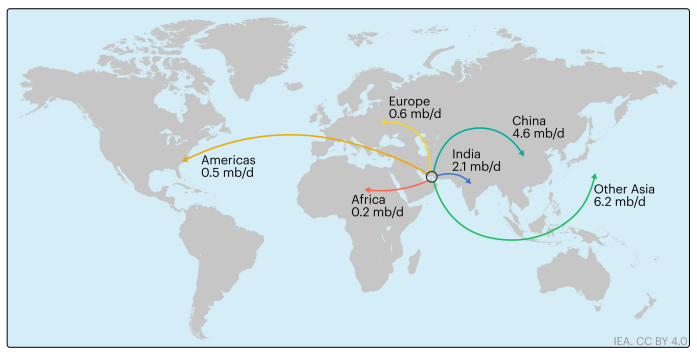 Trade Flow Map
Source: International Energy Agency – IEA
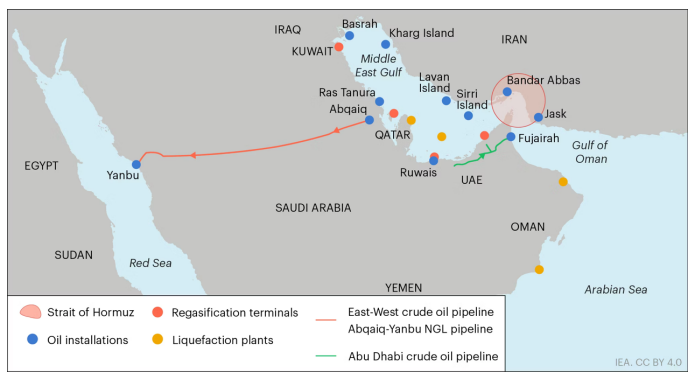
Hormuz Alternative Routes
Source: International Energy Agency – IEA
The European Union was required to respond following an attack on British military installations at Akrotiri in Cyprus. While the incident resulted in no casualties and only minor structural damage, it carried significant political implications. As a result, member states were obligated to uphold Article 42.7 of the Treaty on European Union, which stipulates mutual assistance in the event of armed aggression against any member state.
The European Union has opted to remain strategically detached from military operations in the Strait of Hormuz and Iran, in light of ongoing tensions with the United States and Iran. Unlike the U.S. and Israel, Europe has pursued a different geopolitical path. Although EU member states condemned Iran’s attack on Gulf Monarchies and the EU countries providing military support to these regional monarchies, European leaders have emphasized their intention to avoid direct involvement in hostilities. Instead, they are focused on spearheading an international initiative to keep navigation open through the Strait of Hormuz, which will commence once a sustainable ceasefire is reached.
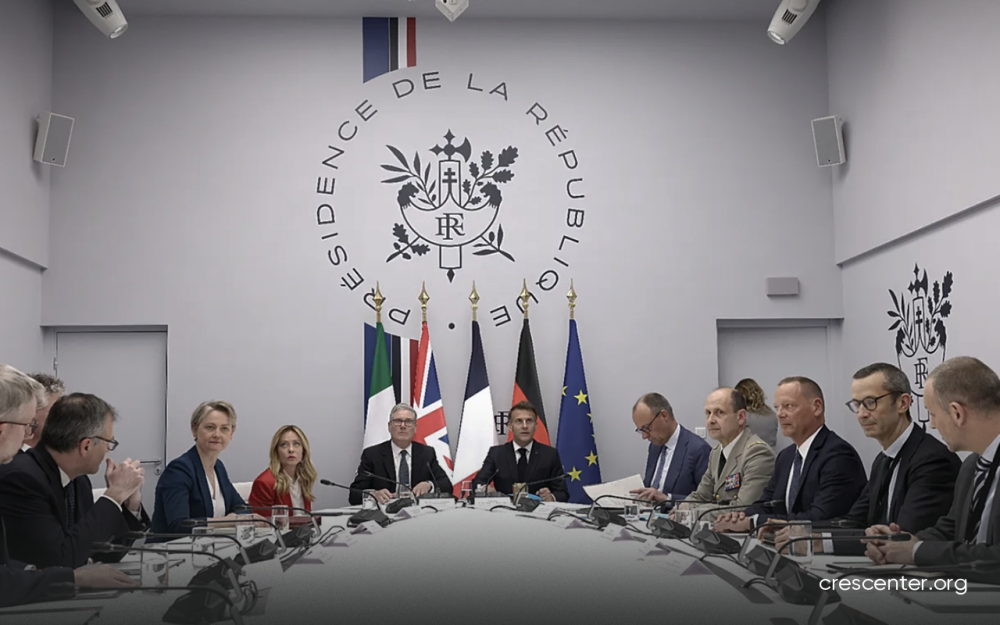
The European mission may be jointly led by the UK and France, as announced by Prime Minister Keir Starmer and President Emmanuel Macron. The operation will remain strictly defensive. Italy is prepared to send naval assets to the Persian Gulf, with Prime Minister Giorgia Meloni stating this continues Italy's role in current European maritime security missions, Aspides and Atalanta, active in the Red Sea, Bab el-Mandeb Strait, and Horn of Africa. During the conflict in the Strait of Hormuz, the United States did not receive the anticipated support from its European allies, as was expected by the Trump Administration. This stands in contrast to the 1991 Gulf War and the 2003 Iraq invasion, during which numerous countries joined Washington's efforts. The Trump Administration appeared isolated, not only among European allies but also within the Anglosphere, particularly with the United Kingdom and Canada. Europe remains mindful of tensions that arose over fourteen months due to actions taken by the White House, such as the imposition of tariffs, the conflict in Ukraine, and disputes regarding Greenland's sovereignty.
Probably, one factor behind the lack of support from European countries is that many allies are increasingly hesitant to participate in U.S.-led coalitions, particularly when such actions appear to benefit American interests more than their own. None of the European member states has forgotten the unsuccessful NATO campaign in Afghanistan, which ended with the withdrawal from Kabul after 20 years of sustained international involvement and the subsequent return of the Taliban regime. The events in Afghanistan deeply impacted European public opinion, which is especially sensitive to issues of human rights and the value of democracy. Another important factor involves Europe's energy security. Since February 2022, when the conflict between Russia and Ukraine began, energy supply has become a significant concern for many European countries. With ongoing tensions in the Strait of Hormuz, Brussels faces the risk of losing access to gas and petroleum, which could affect citizens, families, customers, and European industries. Therefore, the European Union cannot allow itself to be trapped by an ongoing energy crisis.
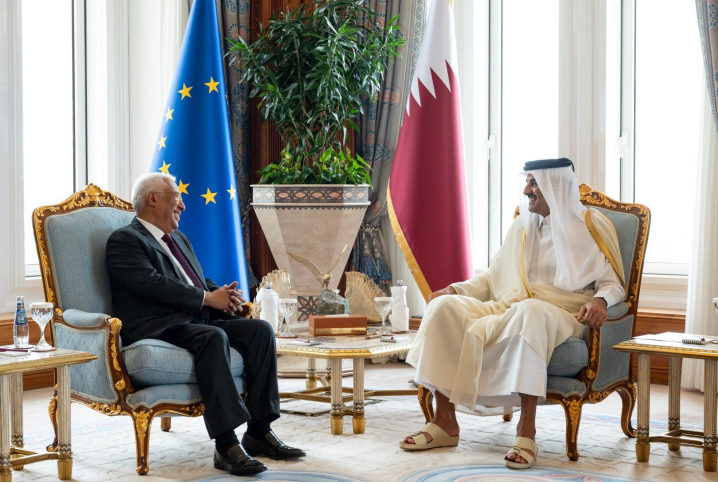
In the described geopolitical context, the principal actors include the Gulf Monarchies. The confrontation with Iran is viewed not only as a military threat but also as a systemic crisis that directly challenges their model of geopolitical power. The domestic stability and international standing of all Gulf Cooperation Council (GCC) member states have historically been based on three key foundational pillars:
• Security, guaranteed by a robust framework of strategic alliances;
• Energy rentierism;
• International reputation, built upon their reliability as global trade and investment hubs.
The international crisis in the Strait of Hormuz has structurally challenged each of these pillars. Consequently, the Gulf states have adopted a risk-averse stance toward Tehran, operationalizing a dual-track strategy: engaging in threat containment while concurrently maintaining open diplomatic channels. This hedging strategy reflects a rational calculus aimed at minimizing the risk of a direct kinetic escalation, recognizing Iran as both a potent security threat and an inescapable, problematic neighbor with whom coexistence is a strategic necessity.
In the context of the current crisis, the United Arab Emirates’ decision to withdraw from OPEC marks a pivotal shift in the recalibration of the Gulf's energy balance. This move underscores Abu Dhabi’s broader economic and political strategy, which increasingly prioritizes national self-interest over cartel cohesion. By exiting the organization, the UAE aims to reclaim complete sovereign autonomy over its crude production quotas, capitalizing on years of heavy capital expenditure designed to maximize the global competitiveness of the Abu Dhabi National Oil Company (ADNOC).
Abu Dhabi's departure is driven by a convergence of economic and geopolitical imperatives. The strategic alignment between the UAE and Saudi Arabia has notably fractured across several regional theaters, including Yemen, Sudan, and their respective diplomatic postures toward Iran. Furthermore, Riyadh’s tightening hegemony over OPEC’s decision-making apparatus has exacerbated bilateral tensions, rendering continued membership untenable for an Emirates explicitly committed to strategic autonomy.
In the Gulf's regional scenario, a recalibration of Washington’s strategic priorities has become increasingly evident, characterized by a pivot toward concentrating military assets and political capital on the defense of Israel. Consequently, the Gulf monarchies increasingly perceive the traditional U.S. security umbrella as neither unconditional nor equitably distributed. This shift occurs against the backdrop of a structural transformation in the regional architecture; while the United States retains its central position, it no longer operates as a hegemonic actor. Instead, the Gulf region is transitioning toward a multipolar configuration, underscored by the expanding economic, technological, and diplomatic footprints of China, Russia, and India around the geostrategic chokepoint of the Strait of Hormuz.
In conclusion, the ongoing conflict within the Gulf littoral marks a watershed period of structural transformation: a region once characterized by relative systemic equilibrium has now mutated into the vortex of a pervasive regional rivalry, directly challenging the decades-long U.S. security architecture. A nascent regional order is emerging, one defined by fragmentation and volatility, wherein calibrating a sustainable geopolitical equilibrium between the Gulf states and the broader Middle East is becoming an increasingly labyrinthine task.
Gabriele La Spina, Geopolitical Analyst in Security, Defence and Strategic Scenarios
for International Diplomatic Institute.