This article is a compliment to CRESCENT Research Center from Gabriele La Spina, Geopolitical Analyst in Security, Defence and Strategic Scenarios for the Instituto Diplomatico Internazionale
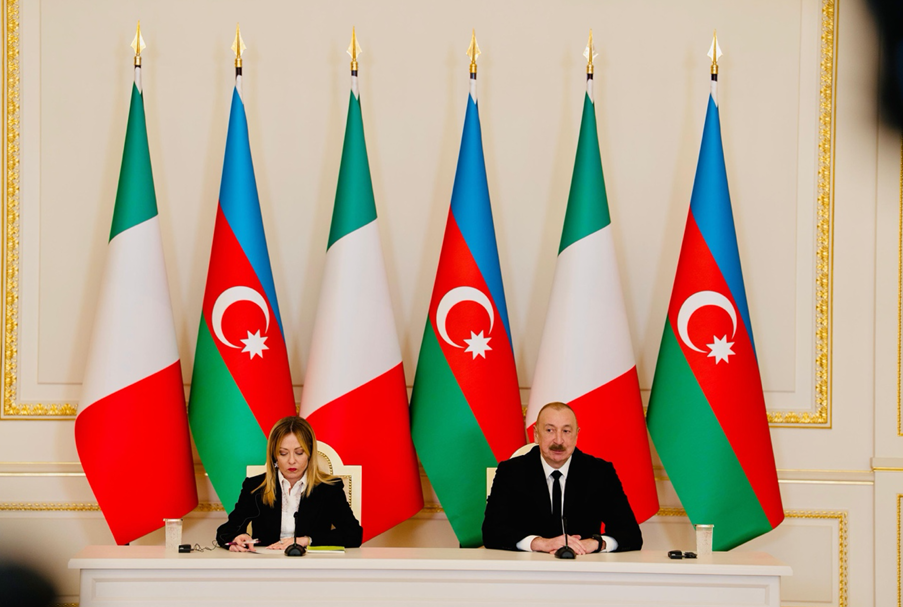
On 4 May 2026, the President of the Italian Council of Ministers, Giorgia Meloni, travelled to Baku, Azerbaijan, to reinforce the strategic partnership between the two nations, focusing on energy, security, and investment. However, it is erroneous to assume that the Italo-Azerbaijani alliance is confined solely to the sphere of energy cooperation; indeed, the two states collaborate actively and profitably across a myriad of sectors, ranging from commerce to culture.
Italy has established a historical bond with Azerbaijan and its population. Diplomatic relations between Rome and Baku began after Azerbaijan declared its independence from the Russian Empire on 28 May 1918. On this occasion, Italy dispatched economic and military delegates to signal its support for the nascent Azerbaijani state. Even during the Soviet era, relations between Italy and Azerbaijan remained robust, demonstrating a collaborative framework that transcended political and institutional transformations.
Following the fall of the Berlin Wall and the dissolution of the USSR, the Prime Minister of Azerbaijan, Hasan Hasanov, travelled to Rome in 1992 for a bilateral meeting with the Italian Prime Minister, Giulio Andreotti. This occasion witnessed the stipulation of numerous strategic agreements that enabled Italy to become the first Western nation to gain access to the Azerbaijani economic market, thereby facilitating the establishment of Italian enterprises in Baku. Since that juncture, a stable and enduring diplomatic, political, and economic relationship has been inaugurated between Italy and Azerbaijan.
On 4 May, the Italian Prime Minister, Giorgia Meloni, conducted an official visit to Azerbaijan, thereby continuing an international trajectory aimed at diversifying and stabilising the national energy supply. Following missions to the Gulf States and Algeria, Baku represented a strategic juncture for Italy’s energy security. Within the contemporary geopolitical context, not only Italy but Europe as a whole faces significant criticalities in the energy sector, linked both to the cessation of Russian supplies resulting from the conflict with Ukraine and to the recent closure of the Strait of Hormuz driven by tensions between the United States, Israel, and Iran.
The Rome–Baku axis acquires strategic value during a period of pronounced geopolitical tension, wherein Europe risks being caught in an energy vice. Thirteen years after the last visit by an Italian Prime Minister to Azerbaijan—undertaken by Mario Monti in 2013—Giorgia Meloni was received with a profound spirit of friendship by the Azerbaijani President, Ilham Aliyev.
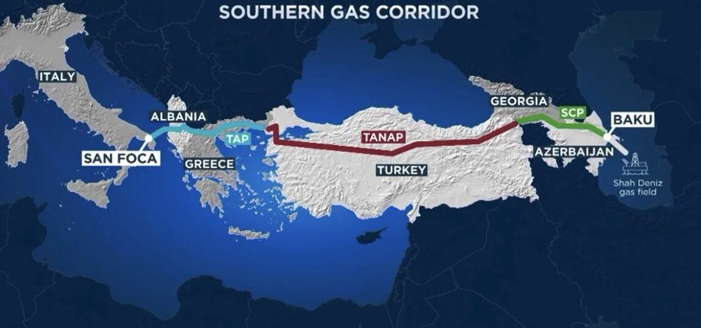
The strategic partnership between Italy and Azerbaijan is predicated upon intergovernmental declarations signed in 2014 and 2020 respectively, which continue to serve as the regulatory framework delineating a multidimensional scope of action for both nations. During the meeting in Baku, President Aliyev emphasised that relations between Rome and Baku are excellent and have reached historical zeniths, confirming Italy’s status as one of Azerbaijan’s most critical partners. To substantiate this assertion, one need only analyse the energy dimension: in 2025, 25 billion cubic metres of gas were exported from Azerbaijan, of which approximately 9.5 billion were destined for Italy, contributing to the satisfaction of 16% of the national energy demand. The infrastructure transporting this so-called ‘Blue Gold’ is the TAP (Trans Adriatic Pipeline), which reaches the coast of Apulia by traversing Turkey and Greece.
The relationship between Italy and Azerbaijan is founded not merely on energy diplomacy, but also on a burgeoning commitment to cultural and scientific diplomacy. Several of Italy’s most renowned universities operate in Baku, having promoted numerous degree courses aimed at training the future Azerbaijani ruling class, thereby transmitting the culture, values, vision, and distinctive managerial competencies of Italy. The President of the Italian Republic, Sergio Mattarella, inaugurated the Azerbaijan Diplomatic Academy in Baku, which incorporates Luiss Guido Carli University, La Sapienza, the University of Bologna, Ca' Foscari University, alongside the Polytechnic Universities of Milan and Turin.
From an economic and industrial perspective, over 130 Italian companies operate actively in Baku, consolidating a significant collaboration between Italy and Azerbaijan. The primary industrial clusters encompass the sectors of defence, security, aerospace, maritime security, and the protection of critical infrastructure. In recent years, Azerbaijan’s interest in Italian industry has grown substantially, as evidenced by the acquisition executed by SOCAR (the State Oil Company of the Azerbaijan Republic), which acquired 98.82% of Petroli S.p.a. (IP, API Group), one of the principal Italian operators in the fuel and mobility segments.
Italian exports to Azerbaijan have registered consistent growth driven by the demand for ‘Made in Italy’ products, spanning sectors such as fashion, furniture, industrial machinery, automotive, and food & beverage. Currently, over 90% of Italian trade within the Caucasus region is concentrated in Baku, which constitutes the primary destination market for Italian goods. Italian enterprises distinguish themselves as strategic partners by virtue of their technological know-how and their capacity to establish e ective relations with Azerbaijani counterparts.
The Italian presence in Azerbaijan has contributed to the economic development and diversification of the Caucasian state. It is appropriate to credit the current President, Ilham Aliyev, with having promoted, from 2015 onwards, an extensive programme of governmental reforms aimed at modernising Azerbaijan and enhancing its competitiveness, implemented progressively across various sectors from the economy to public administration. Particularly relevant have been the incentives deployed to attract foreign direct investment, such as the creation of the Alat Free Economic Zone, which has been operational since 2022.
The recent visit by President Giorgia Meloni has further fortified diplomatic ties, elevating them to a level of permanent political coordination. According to the Italian Head of Government, Azerbaijan represents one of the few reliable international entities for Italy: a strategic partner within a geopolitical context characterised by escalating competition and instability on the periphery of Europe and in the Gulf region. By virtue of this privileged relationship with Baku, Italy aspires to become a European hub for energy supply and a gateway for countries like Azerbaijan into the wider Caucasus area. Rome intends to foster greater integration between the European Union and Azerbaijan, supporting Europe's strategic role and promoting investments in international energy networks and transport systems.
In the realm of foreign policy, Azerbaijan has successfully leveraged both its geographical location and its energy resources to acquire an increasingly significant role within the Eurasian region and at an international level. The strategy pursued is underpinned by two core principles: inclusivity and proactivity. In terms of inclusivity, the country has not only created favourable conditions for investment but has also strategically diversified its investor portfolio, thereby constructing a form of ‘shield’ to safeguard its independence. On the front of proactivity, Baku has actively promoted diplomatic initiatives and assumed the financial burdens indispensable to the development of key infrastructure, through which it has been able to exploit its extractive potential in both economic and diplomatic terms. The most significant manifestation of this strategy is represented by the European Union’s Southern Gas Corridor, a project that would scarcely have been realised without the direct commitment and investments of Azerbaijan.
Since achieving independence, Azerbaijan has adopted a balanced foreign policy, thereby succeeding in evading the dominant influence of the Russian Federation—contrary to the trajectory of other former members of the USSR which, following its dissolution, entered Moscow's orbit. At that historical juncture, such a choice appeared almost mandatory; nonetheless, Baku avoided adopting highly antagonistic stances toward Moscow.
This trajectory represents a rare case study, not only within the South Caucasus but across the entirety of the post-Soviet space. This outcome is the product of a multi-vector approach, predicated upon an alternating strategy of alignment and opposition vis-à-vis Russian regional influence, whilst concurrently maintaining and deepening relations with the United States, Turkey, and the European Union.
On a diplomatic and strategic level, Italy should continue to dedicate significant attention to Azerbaijan, as it has historically done, while seeking to further fortify the partnership between Rome and Baku. This is particularly opportune at present, given that many European nations are not currently engaged or in direct competition with Italy regarding Azerbaijan. From a geopolitical perspective, Rome ought to consolidate its presence in the Caucasus region, as it represents a crucial geographical nexus between Europe and Asia and will, in all probability, acquire ever-greater strategic relevance in the near future.