Europe has spent the better part of the last decade discovering, often painfully, how geography can become a weapon. The Russian invasion of Ukraine exposed the continent's addiction to Moscow's pipelines. The war in Gaza and the American and Israeli confrontation with Iran reminded European capitals just how much of their energy flows through a narrow, increasingly contested chokepoint in the Gulf. The Strait of Hormuz — 33 kilometers wide at its narrowest, yet carrying roughly 20 percent of the world's traded oil — has become an emblem of strategic vulnerability that no European policymaker can afford to ignore.
Many analysts and policymakers have begun asking the same question: is there a route out of this double dependency — one that bypasses both Moscow's leverage and the volatility of the Persian Gulf? The answer, increasingly, is yes. And it runs through the South Caucasus.
A corridor whose time has come
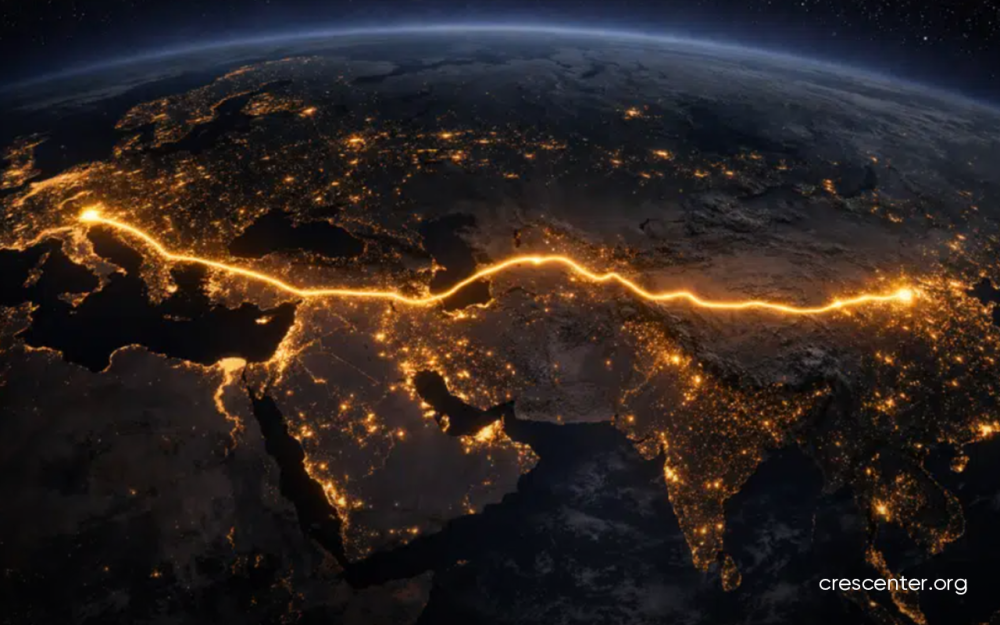
The Trans-Caspian International Transport Route — better known as the Middle Corridor — stretches from China and Central Asia across the Caspian Sea, through the South Caucasus, across Turkey, and into the European Union. It is not a new idea. What is new is the urgency with which it is being treated: not as a commercial convenience but as geopolitical infrastructure, a piece of architecture capable of simultaneously addressing two distinct European dependencies.
Call it “de-putinizing” and “de-hormuzzifying” — neologisms, perhaps inelegant, but precise. The first refers to reducing the structural leverage that Moscow still retains over European energy and commercial flows, even after the gas severance of 2022. The second addresses the subtler but equally dangerous exposure to disruptions at the Strait of Hormuz, through which Gulf producers — Saudi Arabia, the UAE, Qatar — channel much of the energy that keeps European industry running.
The Middle Corridor responds to both challenges at once. And at its center, geographically and strategically, sits Azerbaijan.
The geography of resilience
To understand why Azerbaijan matters so much, it helps to trace what the Middle Corridor actually avoids. Unlike the Northern Corridor — the Trans-Siberian Railway and its offshoots — it bypasses Russian territory entirely. Unlike maritime routes from the Gulf, it does not depend on Hormuz, Suez, or the Mediterranean chokepoints that have proven vulnerable to Houthi attacks, Iranian naval posturing, and the broader instability radiating from an unresolved Arab-Israeli conflict.
The route's logic is one of strategic redundancy. When everything is functioning normally, a ship from Abu Dhabi carrying hydrocarbons to Rotterdam via Hormuz and Suez is fast and cheap. But when everything is not functioning normally — which, in the current geopolitical environment, is an increasingly common condition — the Middle Corridor could become not the plan B, but the only plan.
Azerbaijan is the country whose territory, infrastructure, and diplomatic positioning make the entire western segment of the corridor operable. The port of Alat on the Caspian, currently under major expansion, is the gateway. The Baku-Tbilisi-Kars railway is the spine. And Azerbaijani airspace and territory have remained accessible and stable even as the region around it has periodically convulsed.
The Gulf comes in
The increasing engagement of Gulf sovereign wealth and state-linked capital in Azerbaijan is not coincidental. It reflects a convergence of interests that has been building quietly but is now acquiring structural weight.
Gulf investments in Azerbaijan reached $606 million in the first half of 2025 alone, according to the Eurasian Development Bank. In the same year, the United Arab Emirates and Azerbaijan signed a Comprehensive Economic Partnership Agreement and a joint venture worth one billion dollars between ADQ — Abu Dhabi's strategic holding company — and Azerbaijan Investment Holding. These are deliberate moves by actors who understand that the Middle Corridor, once fully operational, represents a new axis of Eurasian commercial and energy connectivity — one in which Gulf capitals are co-architects.
For the GCC states, the calculus is straightforward. Hormuz is their chokepoint too: any military escalation involving Iran could impede their own export capacity. A diversified route to European markets is in their long-term interest. Azerbaijan, which maintains carefully calibrated but structurally tense relations with Tehran, becomes the natural entry point into this alternative architecture.
It would be tempting to treat Middle Eastern instability as a challenge to the Middle Corridor's viability — if the Gulf is unstable, can it really be a reliable co-investor in transcaspian infrastructure? The question is legitimate, but the logic runs in the opposite direction.
The current regional environment — marked by the fragile aftermath of the June 2025 Israel-Iran confrontation, Iran's continued uranium enrichment at weapons-grade levels, Houthi attacks on Red Sea shipping, and the unresolved power vacuum in post-Assad Syria — does not weaken the case for the Middle Corridor. It makes the case more urgent.
Every week that Red Sea shipping remains disrupted, every month that Iran-Israel tensions simmer, every diplomatic failure in Yemen or Lebanon adds another layer of justification to the infrastructure investments being made in Alat, in Kars, in the Trans-Caspian undersea cable projects that Azerbaijan is advancing alongside its logistical ones.
Europe's responsibility
The European Union has begun to treat the Middle Corridor with the seriousness it deserves. A February 2026 study commissioned by the European Commission mapped investment needs along the Trans-Caspian route as a matter of trade and connectivity policy. The Trans-Caspian Transport Corridor Investors Forum, held in Brussels in late 2025, signaled institutional recognition of the corridor's strategic value.
But recognition is not yet strategy. The gap between acknowledging the Middle Corridor's importance and mobilizing the financial instruments — EIB lending, KfW guarantees, blended finance mechanisms under the Global Gateway — remains substantial. Infrastructure bottlenecks persist: Caspian port capacity, railway gauge interoperability across the Georgian-Turkish border, and the underdevelopment of digital and customs harmonization along the route are not trivial obstacles. They are solvable, but only with the kind of sustained political will that Europe has so far applied to other strategic priorities — semiconductors, defense, green hydrogen — but not yet to this one.
There is also the matter of the Armenian factor. The post-2020 normalization process between Baku and Yerevan has cracked open the possibility of a southern variant of the corridor passing through Armenian territory — potentially connecting to Iran-bypassing routes into the Middle East. This is not yet a reality, but a strategic option whose value increases precisely as the Iranian nuclear file and Hormuz vulnerability become more acute.
Azerbaijan as architect
The most important reframing this article seeks to advance — and the one most consequential for how European and Gulf policymakers think about the Caucasus — is this: Azerbaijan is not merely a geography through which goods and energy pass. It is an active designer of a new Eurasian connectivity order.
This distinction matters enormously. Countries that are conduits depend on the decisions of others. Countries that are architects shape the terms on which others engage. Azerbaijan's combination of energy assets, infrastructural investment, sovereign financial capacity through SOFAZ, and the diplomatic dexterity it has demonstrated in maintaining simultaneous relationships with the EU, Turkey, Russia, and the Gulf states gives it the tools to play the architect's role — if the international community recognizes it as such and engages accordingly.
The double imperative of de-putinizing and de-hormuzzifying Europe's energy and commercial architecture is not a problem that can be solved from Brussels alone, or from Riyadh, or from Washington. It requires a stable, capable, strategically autonomous actor at the junction between the Caspian and the European hinterland.
That actor is Baku. The corridor is the instrument. The time to build it, with the urgency the moment demands, is now.
Piercamillo Falasca
Head of Strategic Foresight Unit, Euro-Gulf Information Centre