
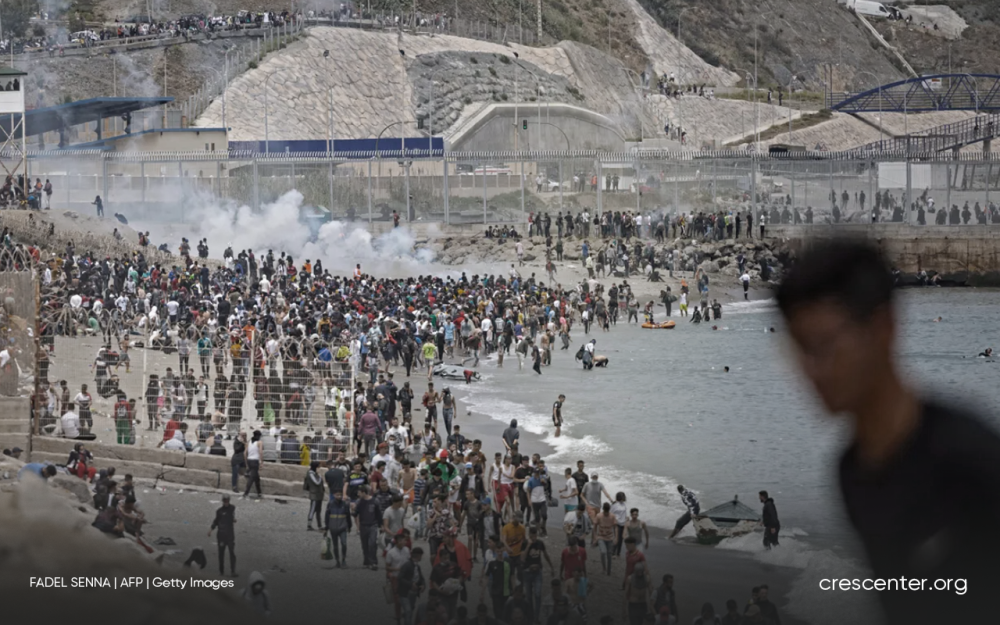
On July 30, an estimated 50,000-60,000 people attempted to cross the border from Morocco to the Spanish autonomous city of Ceuta, overwhelming reception facilities and triggering a humanitarian crisis. The Spanish government deployed the armed forces to restore order, with Prime Minister Pedro Sánchez blaming trafficking networks for violating Madrid’s territorial integrity. The large scale of the migration wave raises concerns over what Moroccan authorities did to contain illegal crossings, particularly considering the increased odds of fatalities; at least 90 people have died as of August 2nd. Likewise, numerous European countries such as Italy, Finland, Denmark, and the Czech Republic called for the suspension of Spain from the Schengen zone, while France tightened its border security. It is therefore important to dive deeper into bilateral tensions between Madrid and Rabat to figure out what is next for Spain’s North African cities.
For decades, bilateral relations have been marked by sporadic tensions and subsequent rapprochement. During the Franco regime, Spain transferred control of Cape Juby (the Tarfaya Strip) to Morocco in 1958 and returned the Territory of Ifni in 1969. Following the Green March and the 1975 Madrid Accords, Spain ended its administration of Western Sahara in early 1976, shortly after Franco's death, although a conflict between the North African kingdom and the Polisario Front plagued the area for the next 15 years. However, it maintained control of the northern cities of Ceuta and Melilla, entities which are disputed by Morocco as remnants of Spanish colonialism. The 1991 Treaty of Friendship, Good Neighborliness and Cooperation set a comprehensive framework for Madrid-Rabat relations, supporting a peaceful resolution to their differences and respecting territorial sovereignty. Since then, the two countries have expanded security cooperation through numerous agreements aimed at strengthening border management and combating terrorism, organized crime, and human trafficking.
Over the last years, cooperation has shifted to the heated issue of immigration. Regional instability caused by the neighboring conflicts in Libya and the Sahel area has culminated in a spike in immigration flows across the Mediterranean, with many people in search of asylum in Europe. For this reason, the European Union has provided Morocco with €215 million since 2001, linking financial allocations to meeting commitments on curbing migration flows. Rabat has taken advantage of its role as a gatekeeper in the Strait of Gibraltar, allowing it to negotiate larger sums with Brussels compared to other North African states and enhance its image as a stable power. Likewise, Madrid alone has given over €123 million to the African nation for assistance on migration and counterterrorism affairs.
Nevertheless, tensions between Morocco and Spain persist in various sectors. First and foremost, the issue of Western Sahara has been of particular importance to Rabat due to complications with the territory’s legal status and the security challenges posed by the alliance of Algeria and the Polisario Front. The United Nations classified Western Sahara as a non-self-governing territory in 1963 and argued that Laayoune does not constitute part of the Moroccan state entity. In theory, Spain supports the self-determination of the indigenous Sahrawi people through a mutually acceptable solution, however, it is reluctant to back independence for the area, primarily due to the importance of Rabat as a regional security partner. Meanwhile, Morocco has proposed a plan to establish an autonomous region in the Sahara, which has been backed by the United States in exchange for the kingdom’s entry into the Abraham Accords, Israel and the European Union. In 2022, Sánchez sent a letter to Moroccan King Mohammed VI supporting the autonomy plan, despite fierce criticism by his left-wing coalition partners and the right-wing opposition.
Secondly, immigration remains a troubling matter for Madrid-Rabat relations amid the intensification of nearby conflicts. In 2021, a major border crisis unfolded when around 8,000 attempted to reach Ceuta and Melilla following relaxed security measures by Moroccan authorities. The incident can be partially attributed to Rabat’s assertiveness in foreign affairs, which became more evident following Trump’s support for the Sahara autonomy plan and the formation of stronger ties with Israel and France. A year later, both kingdoms renewed their security agreement, focusing extensively on countering organized crime and linking it to illegal border flows. Since then, crossing attempts have periodically spiked in 2024 and 2025, however, both sides have prevented a humanitarian crisis.
Finally, the vulnerability of Ceuta and Melilla to external influence remains a particular challenge for Madrid. This July, Sánchez visited Algiers to meet with Algerian President Abdelmadjid Tebboune and agreed to increase natural gas imports by 10% and extend cooperation in other industries, including agriculture and infrastructure. The visit caused irritation to the Moroccan authorities, since the kingdom is a major competitor of Algeria in the energy sector and the border between both North African countries has remained closed since 1994, indicating a significantly bitter dispute. Furthermore, over the last few years, Rabat found a major defense ally in Israel, which has become extremely hostile to Spain since the latter’s recognition of Palestine in 2024. Therefore, some Western intelligence agencies estimate that by relaxing border control enforcement near Ceuta, Rabat aimed to send a message to Madrid to reconsider its re-establishment of ties with Algiers. It is notable that the events in Ceuta bear some similarities to the Evros border crisis in 2020, when around 80,000 refugees attempted to burst into Kastanies, a settlement on the Greek side of the frontier, although no similar large-scale incidents have broken out since then.
All in all, the immigration crisis in Ceuta requires deeper examination into existing bilateral ties between Spain and Morocco and their individual regional partnerships. Madrid’s latest rapprochement with Algiers clashes with Rabat’s regional ambitions, which maintains the ability to leverage migration flows and its alliances with Israel and the United States. Meanwhile, Spain’s capacity to implement stronger deterrence measures relies on unanimous consensus from the European Union and coordination with the political opposition.
Petros Devrikis
Geopolitical Analyst and Master Editor at the Association for International & European Affairs (ODETH)