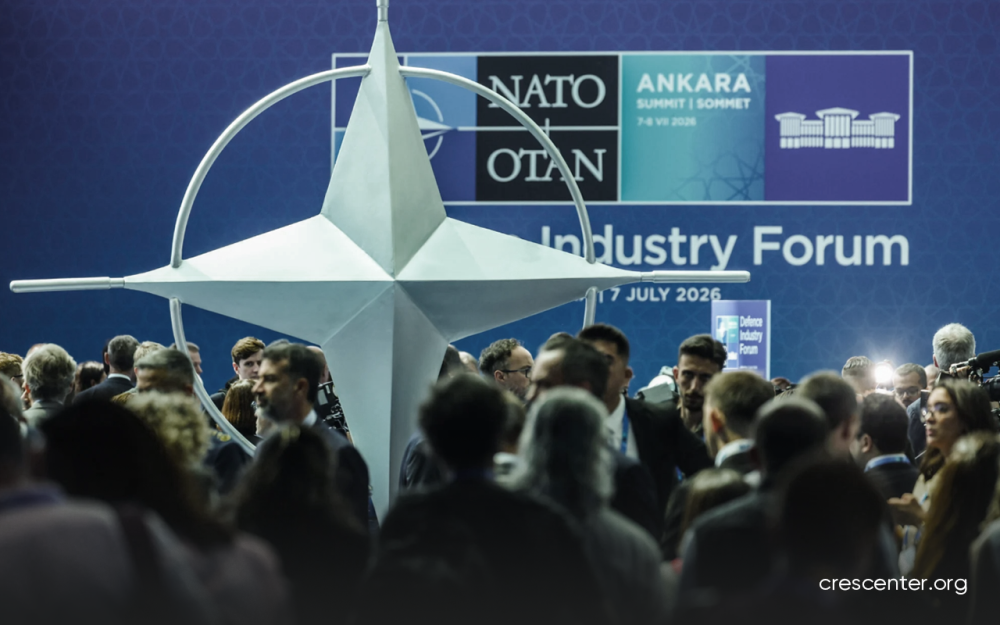
Diplomacy is not conducted solely through declarations, bilateral meetings, and decisions taken behind closed doors. How states are represented—and the setting, protocol arrangements, and historical symbols through which leaders are received—also forms part of diplomatic communication. Official ceremonies, therefore, are not merely decorative appendages to foreign policy; they are communicative arenas in which political meaning is produced. The Type A Ceremonial Welcome held at the NATO Ankara Summit should be assessed from this perspective. The Janissary band, soldiers in historical attire representing the sixteen great Turkic states, and the modern ceremonial formation of the Presidential Guard Regiment together constituted a repertoire of representation that brought historical continuity and contemporary state capacity onto the same stage.
The central narrative implied by this repertoire is clear: Türkiye seeks to be perceived as a pivotal state situated within the institutional architecture of the Western alliance while preserving its historical memory and civilisational claim. Yet in symbolic diplomacy, intention and reception do not always coincide. The meaning of a ceremony is not determined solely by the actor that designs it; as images circulate, they may be reconstructed within different media systems, political alignments, and historical memories. The divergent interpretations of the welcome ceremony in Ankara across Turkish, Western, and Middle Eastern and North African (MENA) media made this contest over meaning visible.
The Circulation of Symbols and Shifting Frames
In Türkiye’s mainstream news narrative, the ceremony was presented largely within a frame of diplomatic capacity and successful summit hosting. A significant portion of the international press, by contrast, addressed the summit through intra-alliance power balances, relations among leaders, and the defence agenda, devoting more limited attention to the ceremony’s symbolic dimension. The picture that emerged in regional media was more fragmented. The same images circulated both as a representation underscoring Türkiye’s regional weight and as a critique of its relationship with NATO.
The first source of this divergence is that the Janissary band and Ottoman imagery do not carry neutral connotations among regional publics. In some outlets, these symbols were interpreted positively through the lenses of shared history, regional self-confidence, and cultural affinity; in publications marked by pronounced opposition to NATO, however, they were read as signs of the tension between historical grandeur and the Western security architecture. The same scene thus became evidence of historical continuity in one reading and the visual expression of a political contradiction in another. This is where the fragility of visual diplomacy becomes apparent: the sending actor may control the design of the message, but cannot fully determine the meaning with which it will be received across different public spheres.
Perceptions of NATO and the Impact of Historical Memory
A second determining factor is the historical and political burden NATO carries among MENA publics. The Alliance is not regarded as a neutral security organisation across all media environments in the region. Military interventions, the regional policies of Western states, and debates over sovereignty have long shaped perceptions of NATO. Consequently, Türkiye’s reception of NATO leaders through a powerful language of protocol was presented in NATO-sceptical outlets as being in tension with Türkiye’s image as an autonomous regional actor.
Within this frame, ordinary protocol elements—such as the red carpet, the arrangement of flags, and the formal order of salutation—could be assigned divergent political meanings even without being detached from their context. While one narrative foregrounded the proposition that “Türkiye is hosting the NATO Summit,” another linked the same images to debates over asymmetrical relations and subordination. The distinction here lies less in the content of the image than in the headline, caption, and language of commentary accompanying it. Media framing makes certain elements visible without wholly altering reality, while relegating others to the background.
Viral Images, Status, and Recontextualisation
Everyday details that went viral during the summit also assumed a distinct function in this process. Leaders’ gait, body language, differences in height, eyewear, or footwear—details that might appear extraneous to the diplomatic agenda—provide material readily suited to the personalisation of politics in digital media. Images that circulated in Western publics primarily for humorous and entertainment purposes were incorporated into debates on status and hierarchy by some regional accounts. By juxtaposing the relatively relaxed demeanour of Western leaders with the host country’s elaborate and disciplined ceremonial order, an implicit contrast was constructed regarding the nature of the relationship between the parties.
This example demonstrates that digital circulation multiplies meaning rather than fixing it. Meme culture is not merely a humorous sphere that lightens politics; it is also a framing instrument capable of connecting a selected gesture or brief image to broader geopolitical narratives. The image itself may not be fabricated; nevertheless, the context in which it is presented can significantly influence viewers’ perceptions of the event. Contemporary debates on disinformation should therefore attend not only to fabricated content, but also to the misleading or one-sided recontextualisation of authentic content.
The Politics of Visibility and the Possibility of Coordinated Narratives
The prominence of the summit’s spectacular imagery on the news agenda also prompted debate in some publications over a politics of visibility. According to these interpretations, the aesthetics of ceremony may function as a form of attention management that relegates criticism of NATO member states’ regional policies to the background. Empirically demonstrating this claim would require a systematic examination of indicators such as the ordering of news items, headline choices, the frequency of visual use, and shifts in the agenda over time. Nevertheless, the debate itself is significant in showing that symbolic diplomacy does not merely produce images; it may also influence which issues become more visible and which remain less so.
Similarly, it would be analytically problematic to characterise all negative commentary either as spontaneously emerging public reaction or as coordinated propaganda. At the same time, the circulation of identical headlines, similar visual pairings, and repeated expressions at short intervals across particular media networks and their affiliated social media accounts warrants further investigation into the possibility of coordination. Reaching such a conclusion would require data such as network analysis of inter-account connections, patterns of synchronised posting, and content similarity. What can be established is that the available images can readily be incorporated into pre-existing narratives depicting Türkiye as “the West’s regional proxy.” What is at stake here is less the production of false information than the placement of an authentic image within a selective context.
Avoiding the Treatment of Regional Media as a Monolithic Bloc
The comparative assessment also reveals the limitations of broad categories such as “Arab media” or “regional media.” While some Gulf-based outlets employed more measured language that foregrounded Türkiye’s mediation capacity and the summit’s diplomatic significance, sceptical frames were more visible in media outlets aligned with Iran or those that have made opposition to the West a central element of their editorial line. It is therefore insufficient to construct the unit of analysis solely on the basis of geography. The ownership structure, political affiliations, target audience, and the host country’s relationship with NATO must be assessed together.
This distinction is also methodologically important. A robust assessment of regional media should state clearly which outlets were examined, the time period covered by the sample, and how news reports, commentary, and social media content were distinguished from one another. Otherwise, there is a risk that a handful of striking posts will be presented as representative of the position of an entire regional public. Yet the discursive diversity surrounding the Ankara Summit requires us to speak not of a single “regional response,” but of competing geopolitical interpretations.
Conclusion
The welcome ceremony of the NATO Ankara Summit offers an illuminating example of both the possibilities and the limitations of visual diplomacy. Through the ceremony, the state brought historical continuity, institutional capacity, and its claim to pivotal-state status together on the same stage. Yet once this scene moved beyond national borders, it was reinterpreted through different historical memories, political positions, and media frames.
From the perspective of public diplomacy, the lesson is not to dispense with symbols, but to regard processes of reception as an integral part of communication design. How an image will be received by domestic audiences can be anticipated to a certain extent; in transnational circulation, however, control over meaning diminishes. Effective public diplomacy must therefore focus not only on which image is to be produced, but also on the historical and political frames through which that image will be encountered by different publics. The ceremony in Ankara became the stage not for a single message, but for multiple contests over meaning conducted through the same image.