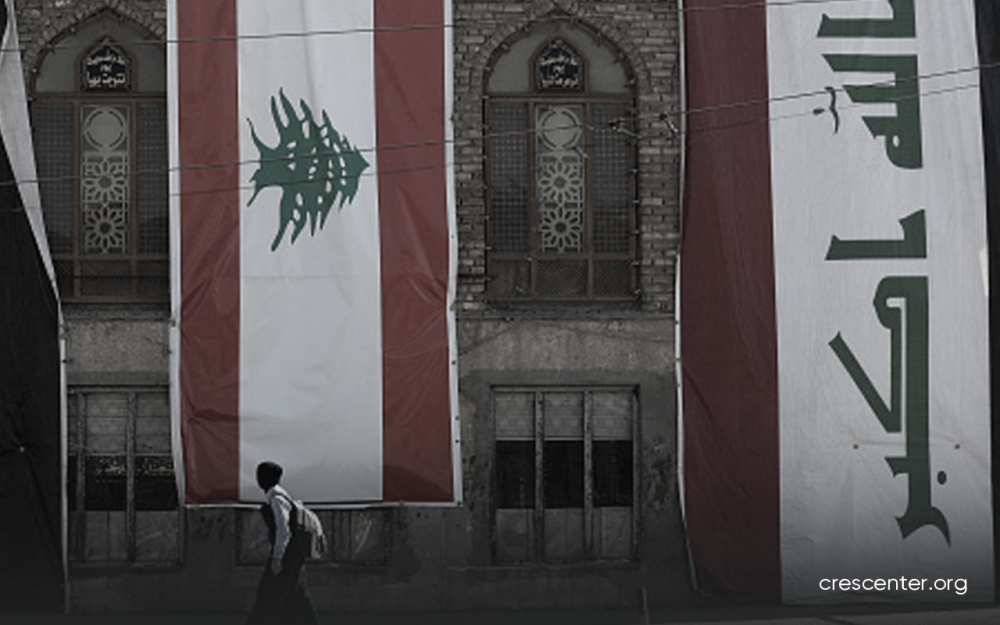
In the wake of the 40-day war with Iran, Washington has intensified efforts to dismantle Tehran’s regional armed networks, increasing pressure on Baghdad to disarm Iran-linked militias in Iraq, while brokering talks aimed at Hezbollah’s disarmament in Lebanon.
Amid renewed and escalating tensions with Iran, the US has continued its push to disarm these Iran-linked actors. Iraq’s new Prime Minister Ali al-Zaidi met with US President Trump in Washington on 14 July to discuss US investment in Iraq - something US officials have repeatedly linked to Baghdad disarming Iran-linked militias and excluding their leaders from politics.
While some such militias, including Asa’ib Ahl al-Haq (AAH), have announced their willingness to disarm, other groups with closer ties to Tehran, such as Kata’ib Hezbollah and Harakat Hezbollah al-Nujaba, have refused. In addition, even groups such as AAH may condition implementation on guarantees that their political and economic interests will be protected.
In Lebanon, several rounds of US-brokered talks between Israel and Lebanon resulted in an agreement that would see Beirut gradually disarm Hezbollah in return for Israel’s withdrawal from southern parts of Lebanon. Tehran has condemned the 26 June agreement as a violation of the US- Iran Memorandum of Understanding, which called for the end of US and Israeli military activity in Lebanon.
While both initiatives are framed as efforts to strengthen state sovereignty, they are unfolding amid unresolved regional tensions, and within domestic political systems where these armed actors remain deeply embedded.
The comparison raises a broader question: do the domestic and regional conditions necessary for sustainable disarmament actually exist in either Iraq or Lebanon?
Regional Disarmament Amid Iran-US Tensions Remains Unlikely
Escalating tensions between the US and Iran complicate efforts to disarm the Iraqi militia groups closest to Iran. Groups such as Kata’ib Hezbollah and Harakat Hezbollah al-Nujaba - which played a key role in launching attacks on US political, military and commercial sites during the recent war - remain ideologically aligned with Tehran. Reflecting this, Abu Hussein al-Hamidawi, Secretary General of Kata’ib Hezbollah earlier this month urged Baghdad to resist “arrogant imperial projects”, and reiterated that the group remains ‘committed to the Islamic Resistance and its weapons”.
Unlike other Iran-linked Iraqi groups - such as the Badr Organisation and Asa’ib Ahl al Haq - which have over the years become deeply embedded in Iraqi politics, these organisations remain more closely aligned with Tehran, politically, ideologically and strategically. As a result, they will likely continue to refuse to disarm, particularly while the prospect of a renewed US-Iran war looms large.
Lebanese Hezbollah is highly unlikely to agree to disarm, irrespective of whether the US-Iran-Israel war resumes. The group resumed missile and drone attacks on Israel on 2 March, both in support of Iran during the 40-day war, and in response to repeated Israeli attacks on Lebanon, despite a ceasefire signed by both parties in November 2024. As a result, even an end to the Iran-US war is unlikely to bring about conditions for their disarmament.
However, renewed Israeli attacks on Iran are likely to result in both resumed Hezbollah attacks on northern Israel, and further Israeli incursions into Lebanon. A sustained conflict between Hezbollah and Israel would only further complicate any attempts by Beirut to implement the 26 June agreement.
Enforcing Disarmament
Washington’s objectives in Iraq appear to extend beyond disarmament. On 23 June US Charge d’Affairs Joshua Harris stated that the inclusion of actors in the new Iraqi government that the US considers “terrorists” would make US-Iraq relations unworkable. These reportedly include individuals affiliated with Kata’ib Hezbollah, Asa’ib Ahl al-Haq, Harakat Hezbollah al-Nujaba, Kata’ib Sayyid al-Shuhada, Kata’ib Imam Ali, and Harakat Ansar Allah al-Awfiya.
However, groups such as Asa’ib Ahl al-Haq likely will not begin disarming - despite their recent pledge to do so - without guarantees from Baghdad that their political and economic interests will be protected. Such groups have embedded themselves deeply in Iraq’s political and security apparatus, deriving significant influence from these positions. As a result, it remains unclear how Baghdad could enforce such a mandate.
Enforcement also remains an issue in Lebanon. In the Israel-Lebanon agreement signed on 26 June, the Lebanese Armed Forces (LAF) would deploy to two pilot zones south of the Litani river, and disarm Hezbollah fighters there. However, there is little evidence that the LAF is capable of doing so; on 3 March, Beirut banned all of Hezbollah’s military and security activities, but has proven unable to enforce this decision.
Risks of Civil Conflict
A coercive disarmament process in Iraq would plausibly result in some degree of civil conflict. This has been the case in previous years; days-long clashes in Baghdad’s Green Zone erupted in August 2022 after other political parties blocked Sadrist ambitions in the legislature.
Such an escalation would be plausible in the event that Baghdad moves to sideline all militia leaders from government positions, or in the event that authorities attempt to compel groups such as Kata’ib Hezbollah or Harakat Hezbollah al Nujaba to disarm, without involving Tehran in the process. The Islamic Resistance in Iraq (IRI) is estimated to field around 50,000 fighters alone, and substantial arsenals including small arms, rockets, armed drones and heavy weaponry.
Absent a wider regional settlement, attempts to disarm Hezbollah are likely to remain constrained by the same security and political dynamics that have frustrated similar efforts elsewhere. In particular, attempts by the LAF to forcibly disarm Hezbollah risk reigniting civil conflict in the country.
Zahra Ladha - Geopolitical Analyst focused on Iran, Iraq and the GCC