
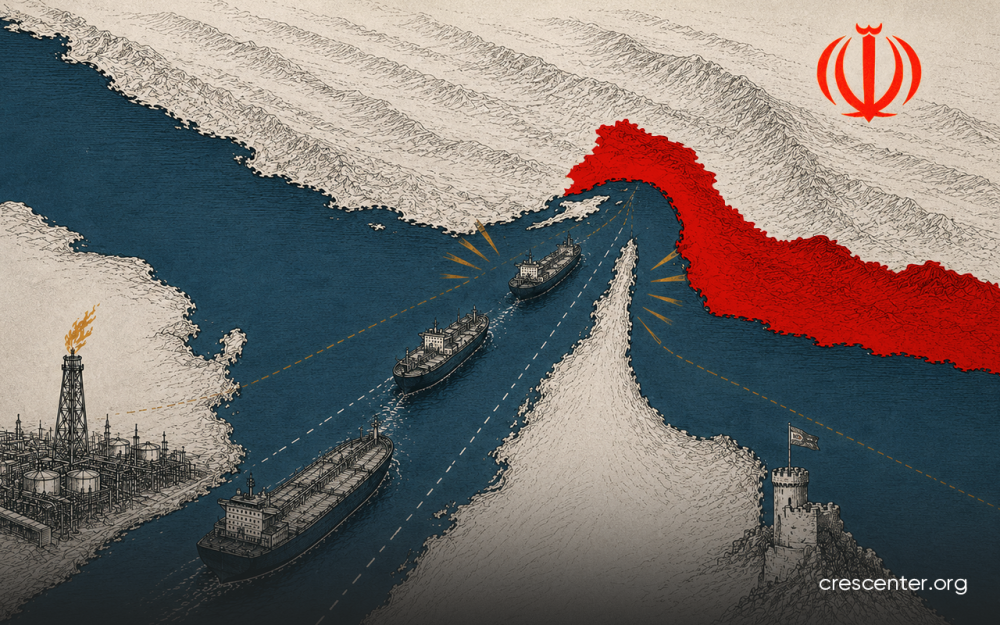
The declared armed attack against Iran by the United States and Israel on 28 February 2026 has created a critical situation in the region, which led to the closure of the Strait of Hormuz by Iran, as previously announced to use it as a defense leverage. This closure makes ship traffic through the Strait stand at well below 10% of normal volumes, despite the Iran-US ceasefire. Hundreds of tankers and other ships have been stuck inside the Gulf, cutting global oil supply by 20% in the world’s biggest-ever supply disruption. IMO has also reported that around 20,000 seafarers on nearly 2,000 vessels were affected, and at least 21 incidents of damage to commercial vessels were reported by mid-March, which have raised serious legal and humanitarian concerns. The closure of the Strait, the laying of mines within the Strait, the imposition of tolls, and the precise scope of Iran’s sovereign rights and those of other states are all issues that must be examined in order to achieve a clearer understanding of the situation.
Strait of Hormuz: Geographical and Legal Status
The Strait of Hormuz is geographically narrow, with the width varying between 17 and 30 nautical miles and bordered by Iran and Oman. The Strait is at its deepest close to the Iranian coast, and since both Iran and Oman have established 12-nautical-mile width for their respective territorial seas, the entire navigable width of the Strait is effectively overlapped by the territorial waters of these two countries. The Strait of Hormuz is one of the world’s most strategically significant waterways, linking the Persian Gulf with the Gulf of Oman and the Indian Ocean. Its importance stems from the fact that it serves as the principal maritime corridor for the export of oil-producing states like the UAE, KSA, Kuwait, and Qatar. According to statistics, approximately 20% of globally traded crude oil and significant volumes of Liquefied Natural Gas (LNG) pass through the Strait on a daily basis, making it the most critical energy chokepoint in the world. Disruption to navigation-even temporarily- will trigger sharp fluctuations in global energy stability and security. These characteristics of Strait have created a unique situation where regional security dynamics, foreign naval deployments, and global energy markets converge, heightening the Strait’s vulnerability to political and military tensions.
From a legal perspective, the status of international Straits is shaped by the international law of the sea, particularly the United Nations Convention on Law of the Sea 1982 (UNCLOS) and customary international law. According to article 38(2) UNCLOS, the legal regime applicable to straits used for international navigation is that of transit passage. Transit passage applies to straits which are used for international navigation between one part of the high seas or an exclusive economic zone (EEZ) and another part of the high seas or an exclusive economic zone. Under this convention, transit passage through international straits “shall not be impeded”, meaning it cannot be suspended or interrupted (Art. 44), and therefore, States cannot impose fees on it merely for the passage itself. Thus, the Strait of Hormuz meets the criteria to be characterized as a strait used for international navigation. However, the applicability of this standard to it is a subject of legal debate. The core of this dispute lies in the fact that Iran is not a party to UNCLOS. Iran signed UNCLOS on December 10, 1982, yet has refused to ratify the Convention. More significantly, at the time of its signature, Iran issued an interpretative declaration based on Article 310 of UNCLOS, highlighting that certain provisions of the Convention were merely the result of a quid pro quo arrangement and did not necessarily codify existing custom or represent established practice. Therefore, Iran does not see itself as obligated by the rules of transit passage. Although, some countries like US and UK, argue that transit passage has attained the status of customary international law, applicable to non-party states to the UNCLOS, Iran has maintained a persistent objection to application of transit passage in the Strait and declared innocent passage is the only legal regime applied to Strait of Hormuz. in this regard, under international law, a customary rule is not applicable to a state that has persistently and explicitly objected to it during its formation; consequently, such a customary rule cannot be invoked against Iran.
On the other hand, according to Part II, Section 3 of UNCLOS, Innocent Passage is not an absolute and unrestricted passage. Such passage is subject to the conditions not prejudicing peace, order, or security of the coastal State, which maintains the competence to regulate navigation, including the right to temporarily suspend passage for security or environmental reasons. In other words, Iran’s sovereign rights are exercised through the implementation of specific security regulations aimed at ensuring that the passage of foreign vessels does not prejudice the peace or security of the coastal state. These rights are typically manifested through procedures such as monitoring the presence of foreign vessels, requiring prior notification or authorization for specific types of navigation, and conducting inspections when there are reasonable grounds to suspect that a vessel is engaged in activities inconsistent with innocent passage—such as intelligence gathering, military exercises, or the use of weapons. But these rights don’t give Iran the competence to close an international strait completely, lay mines to disrupt navigation, or impose tolls just for passing. In other words, the inherent right of Iran to secure its waters is fundamentally distinct from any intent to disrupt the global flow of commerce or threaten international energy security. Consequently, these security-based restrictions must never extend to non-military or commercial shipping. Because non-military vessels are inherently non-threatening and serve the common interest of global economic stability, their right to passage should be protected as a matter of policy and international stability. By clearly demarcating this boundary, Iran should ensure that its security measures—which are exclusively reserved for intercepting the military activities of belligerent states—do not impede the essential movement of global trade or interfere with the navigation of third-party vessels. It is crucial to emphasize that the exercise of these regulatory measures must remain strictly proportionate and non-discriminatory toward commercial maritime traffic. At the same time, Iran maintains that any restrictions it imposes in the Strait of Hormuz are not intended to close the waterway, but to regulate passage under these unique conditions. Measures such as prior notification, routing requirements, enhanced monitoring, and targeted inspections are framed as security-driven tools to distinguish between neutral and non-neutral traffic. In any event, protective measures or security restrictions cannot justify, or be used as a pretext for, the complete or discriminatory closure of the Strait of Hormuz or for violating freedom of navigation. Any such measures must remain within the limits of maritime law. Tehran has stated that vessels must coordinate with its naval authorities when transiting the Strait, while maintaining that the waterway remains open in principle and that restrictions apply only to “enemy-linked” ships.
Another particularly sensitive issue concerns the legality of imposing tariffs or fees in the Strait of Hormuz. Under the general principles of the law of the sea, coastal states may not levy charges merely for the transit of foreign vessels through straits used for international navigation. Accordingly, a clear distinction must be made between unlawful transit tolls and permissible charges for specific services actually rendered. Even in such cases, however, any fees must be strictly limited and must not serve as an indirect restriction on freedom of navigation.
Conclusion Remarks:
In conclusion, this analysis clarifies that the applicable legal regime governing the Strait of Hormuz is innocent passage, which provides a functional framework for the Strait’s regulation and is consistent with sovereign rights and duties of the coastal state, Iran. This legal regime allows Iran to adopt proportionate and non-discriminatory measures to safeguard its security, provided that such actions do not interfere with the continuous and expeditious passage of non-military and commercial vessels and should remain focused on specific security objectives rather than impeding general navigation and security of international commerce. Consequently, security limitations imposed by Iran must be according to maritime law and must not impose an undue burden on non-military vessels.
Sara Famoori